
How Does a Hook Type Shot Blasting Machine Work?
By Robert Li, Shot Blasting Equipment Engineer, Botou Junda Machinery Equipment Co., Ltd. Robert Li is a shot blasting equipment engineer at Botou Junda Machinery Equipment Co., Ltd. in Botou, Hebei, China's foundry machinery base. He has 20 years of experience with wheel blast cleaning systems in Vietnam, Malaysia, Indonesia, India, and South Korea.
A hook type shot blasting machine cleans heavy metal parts while they hang from an overhead rail and spin inside a sealed chamber. Blast wheels throw cast steel shot at a tip speed near 80 m/s, and the stream strips rust, mill scale, and sand from every exposed face. It cleans large, dent-prone workpieces without dropping or tumbling them.
What Is a Hook Type Shot Blasting Machine Used For
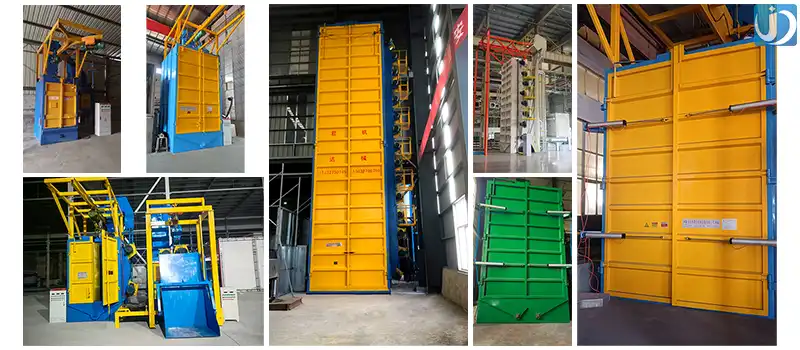
A hook type shot blasting machine is a batch blast cleaning system built around one overhead hook. A hoist lifts the workpiece onto the hook, and a trolley carries it along a rail into a sealed chamber. Doors close, wheels start, and the hook rotates the part while abrasive strikes it from several angles. Standard Q37-type machines take hook loads from 500 kg to 10,000 kg.
Foundries, pressure vessel shops, and large die works use a hook type shot blasting machine for parts that cannot tumble. A tumble belt machine throws workpieces against each other. That dents thin walls and snaps slender features.
Three Production Cases from the Field
Pressure vessel shells. A welded shell two meters long and two tonnes is impossible to tumble. Hand grinding around nozzles and saddle welds is slow. On a hook type shot blasting machine it rotates past wheels that reach the outer surface, the seams, and part of the bore.
Wind turbine hub and gearbox castings. A single hub often weighs one to five tonnes. One hook machine cleans it in a single pass. Global wind installations hit 165 GW in 2025, up 40 percent (Global Wind Energy Council, 2026).
Machine tool beds and large die blocks. Ribbed cast iron beds have deep pockets. Rotation swings those pockets into the blast stream, and the absence of tumbling protects finished faces.
Send Junda Machinery your part drawing before you shortlist any hook type shot blasting machine manufacturer. We size chamber, hook tonnage, and wheel layout against your largest workpiece, then quote the build for your local voltage and dust rules. Email junda001@jundablast.com with the heaviest part you run, and engineers reply within 6 to 8 hours.

How a Hook Type Shot Blasting Machine Works Step by Step
Every cycle on a hook type shot blasting machine runs the same four stages. The controller locks the sequence, so the operator sets a program once and repeats it.
1. Load, hang, and seal. A hoist lifts the part onto the hook. The operator checks balance, adds a fixture when needed, and confirms the latch is closed. A trolley then runs along the overhead rail and stops at the chamber center. The door closes, and a limit switch confirms full closure before any wheel can start.
2. Start the handling equipment. The controller starts the separator, then the bucket elevator, then the screw conveyor, and only then the blast wheels. That order matters. Abrasive has to move through the loop before the wheels fling it, or shot piles up on the chamber floor and jams the conveyor.
3. Blast and rotate. Blast wheels throw steel shot across the rotating part. Rotation speed sits on a variable frequency drive and usually runs between about 3 rpm and 20 rpm. Heavy boxy parts turn slowly so the blast stream dwells on each face. Small parts spin fast for wider coverage in the same cycle.
4. Blow off and return abrasive. When the timer ends, the wheels stop and a blow-off manifold clears loose shot from the part. The door opens and the hoist lowers the workpiece. Shot and dust drop through a floor grate onto a screw conveyor, which feeds an elevator and an air-wash separator.
What the Control System Checks Before Blasting
A modern controller verifies door lock, hopper level, dust collector status, and wheel motor current before it releases a cycle. It logs cycle time and shot consumption per batch, which flags a worn blade early. Junda fits its own monitoring software to every hook type shot blasting machine we build.
Inside the Blast Chamber: Hook, Wheels, and Abrasive Flow
Three systems decide how well the chamber cleans. The hook and rail position the part. The blast wheels supply the energy. The liner and seals protect the steel box.
Component | Job it does | What to check on a quote |
Blast wheels | Throw abrasive at the workpiece | 2 to 7 wheels, 11 to 15 kW each, shot speed near 80 m/s |
Chamber liner | Absorb direct blast impact | Mn13 manganese plates, replaceable in hot zones |
Hook and rail | Carry and rotate the part | Hook tonnage vs your heaviest part, separate rotation drive |
Door seals | Hold shot and dust inside | Rubber strips plus felt brushes, interlocked limit switch |
Separator | Strip dust and broken shot | Air-wash design, reclaim above 99 percent |
Dust collector | Hold inward airflow at every opening | Extraction sized to chamber volume and door count (OSHA, 2026) |
How Blast Wheels Are Positioned
Wheel placement matters more than wheel count. Builders mount wheels in symmetric pairs, angled into the rotation direction so the pattern sweeps across the part. Overlapping patterns beat one strong pattern. Gaps between blast fans show up as unblasted stripes. A hanger system built for rail weldments held SA 2.5 with roughness of Ra 6 to 12 micrometers (Foundry-Planet, 2017). On a hook type shot blasting machine, two or three wheels usually cover the whole part.
The Abrasive Return Loop in Three Stages
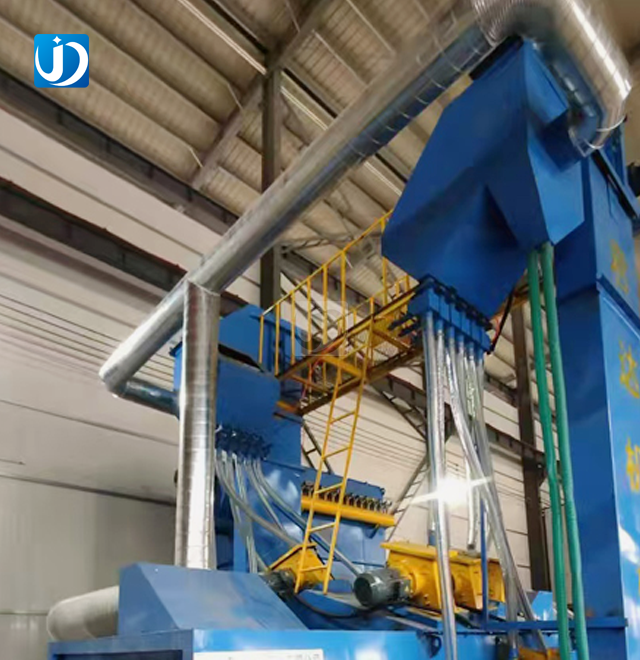
A hook type shot blasting machine recycles abrasive through three linked machines. Shot drops into a screw conveyor at the chamber floor, which pushes the mix to the elevator. Buckets lift it to the top. A cross-flow of air then blows dust and broken shot out of the stream while good shot returns to the hopper.
What Dust Control Numbers Must You Hit?
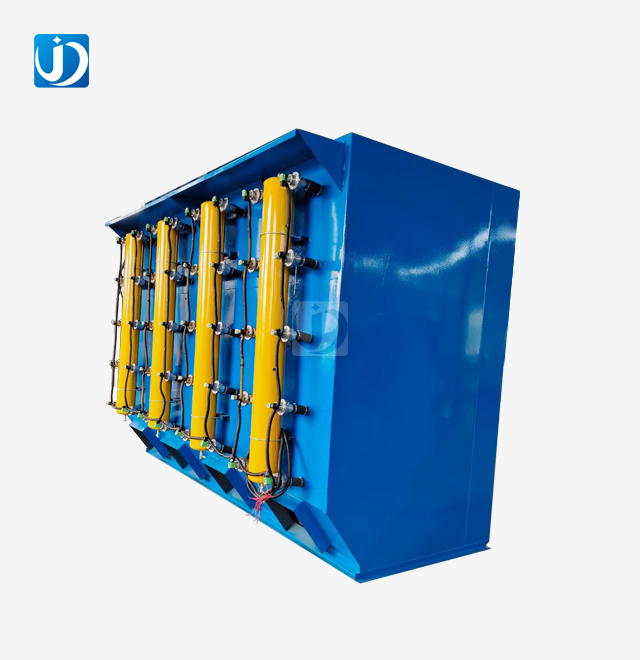
Safety setup on a hook type shot blasting machine starts with the enclosure. OSHA requires exhaust ventilation that holds continuous inward airflow at every opening. Duct velocity should hold near 4,500 feet per minute in branch ducts and 3,500 feet per minute in the main (OSHA, 2026). Ask your supplier for extraction volume, then check it against chamber volume and door count.
Single Hook vs Double Hook vs Continuous Hook Systems
Hook arrangement on a hook type shot blasting machine decides throughput more than wheel power does. A single hook machine has one rail position, so the part loads, blasts, and unloads in sequence. A double hook machine uses a Y-shaped rail, so one hook blasts while the operator loads the other one.
Arrangement | How parts move | Best fit |
Single hook | One hook, load and blast in sequence | Single heavy parts, low volume |
Double hook, Y rail | Two hooks alternate on a Y rail | Batch work where load time is lost time |
Continuous spinner hanger | Monorail trolley passes straight through | High volume weldments on a paint line |
Which Hook Arrangement Matches Your Batch Size?
Under about 20 parts per shift on a hook type shot blasting machine, a single hook is enough, and the extra money buys more chamber size instead. Between 20 and 60 parts, a double hook pays for itself through overlap of load and blast time. Above that, a continuous spinner hanger wins.
Why Rotating the Workpiece Improves Cleaning Uniformity
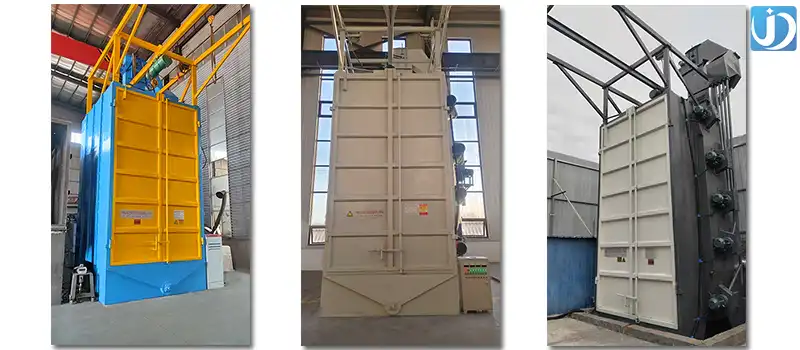
A blast wheel throws abrasive in a fan pattern. Nothing in that fan lands on the back of the part. Rotation is the part of a hook type shot blasting machine that buyers underestimate. As the hook turns, every face passes through the fan. Coverage comes from motion rather than from more wheels. Rotation also reaches open cavities, stiffener ribs, and weld toes.
How Rotation Speed Changes the Result
Rotation speed is a process variable, not a fixed setting. On a hook type shot blasting machine the rotation drive works independently of the hoist. A slow turn gives each square centimeter more time under the blast stream. A fast turn spreads abrasive over more surface in the same cycle.
Workpiece type | Typical rotation | Why it works |
Heavy casting with thick scale | 3 to 6 rpm | Longer dwell per face breaks down burn-on sand |
Boxy fabrication with internal ribs | 6 to 12 rpm | Balances outer faces against cavity exposure |
Small parts on a fixture | 12 to 20 rpm | Wide coverage when cycle time matters |
What Shot Blasting Media Works Best in a Hook Machine
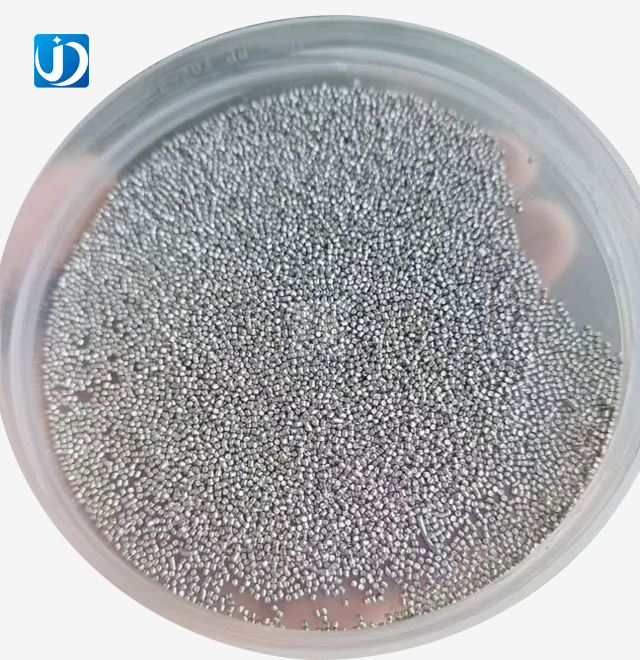
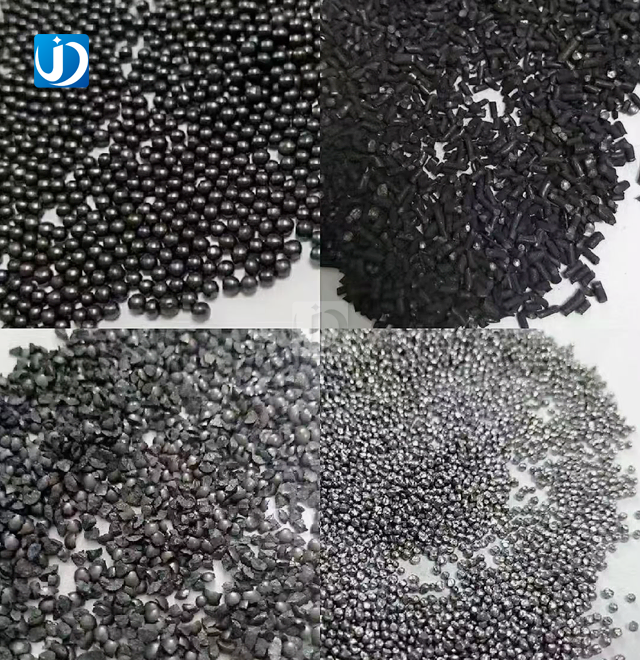
Cast steel shot is the default abrasive for wheel blast cleaning. Sizes in the 0.2 mm to 0.8 mm band cover most foundry and fabrication work. Shot alone leaves a rounded, peened profile. Steel grit has sharp edges and leaves an angular profile. High-build coatings need that angular anchor pattern (Steel Construction Institute, 2026).
Mixing both is common practice. A blend near 70 percent shot and 30 percent grit gives decent cutting speed plus an anchor profile a coating inspector will accept.
Which Shot Size and Mix Should You Start With?
Job | Starting media | Reason |
General castings, light rust | S230 steel shot | Good balance of speed and wheel wear |
Heavy burn-on, thick scale | S330 to S390 shot | Heavier particle, harder hit |
Pre-paint under a coating spec | 70/30 shot and grit | Angular profile improves adhesion |
Blast Cycle Time and Productivity Data for 2026
Blast time on a hook type shot blasting machine usually runs 3 to 7 minutes for a mid-size part. Load and unload add 2 to 4 minutes on a single hook. A double hook machine overlaps that handling time, so throughput can rise 30 to 50 percent. One 2-tonne shell at 6 minutes of blast time gives about 6 parts per hour.
The global shot blasting machine market was worth USD 1.48 billion in 2026, with 7.7 percent annual growth forecast to 2034 (Fortune Business Insights, 2026). Global steel demand should grow 0.3 percent in 2026 to 1,724 million tonnes (worldsteel, 2026).
What Slows a Hook Machine Down, and How to Spot It
Contamination is the common answer. Thick sand burn-on needs more blast time, and operators extend the timer. Fixture problems slow rotation, because a swinging part forces the operator to cut speed. Worn blades widen the pattern and drop impact speed, so cleaning falls while media use rises. Stripes point to worn blades, and media loss points to a bad separator.
Hook Blasting vs Sandblasting: Surface Quality Compared
Hand sandblasting and a hook type shot blasting machine can both reach Sa 2½, the very thorough blast cleaning grade in ISO 8501-1. The difference is repeatability. A hook machine holds the same wheel position, rotation speed, and cycle time for every part, so cleanliness stays inside a narrow band all shift. Sa 2½ allows only slight staining (Steel Construction Institute, 2026).
Health risk is the harder argument. NIOSH has recommended banning silica sand for abrasive blasting since 1974. An estimated 100,000 American sandblasters were at risk of silicosis, and a NIOSH alert documented 99 cases among sandblasters aged 23 to 55 (NIOSH, 2026).
Where the Money Actually Goes
Operating cost on a hook type shot blasting machine splits between power, abrasive, wear parts, and maintenance labor. A machine drawing 30 kW over a 6 minute cycle uses about 3 kWh per part. Abrasive loss is the larger variable, and separator tuning, liner condition, and blade wear all move it.
Conclusion
A hook type shot blasting machine earns its place when parts are too heavy, too large, or too delicate to tumble. The hook carries the workpiece, and rotation puts every face in front of the blast stream. A closed abrasive loop keeps the process repeatable. Choose the hook arrangement from your parts per shift, and size the chamber from your largest workpiece.
FAQWhat is a hook type shot blasting machine used for?
A hook type shot blasting machine cleans heavy or awkward metal parts one at a time, or in small batches on a fixture. Typical work includes pressure vessel shells, wind turbine castings, machine tool beds, and large dies. It removes rust, mill scale, sand, and old coating before paint.
How many parts per hour can a hook machine clean?
A single hook machine with a 6 minute blast cycle and 4 minutes of handling runs about 6 parts per hour. On a hook type shot blasting machine with a double hook, loading overlaps blasting and throughput often reaches 8 to 9 parts per hour at the same cycle time.
Can a hook machine reach Sa 2½ in one pass?
Yes, when the wheels cover the whole part and rotation speed matches the workpiece. Sa 2½ is the very thorough blast cleaning grade under ISO 8501-1, and it allows only slight staining. The reference photographs in the standard settle any dispute about whether a surface passed.
Should I choose a single hook or a double hook machine?
Match the choice to parts per shift. Under about 20 parts per shift, a single hook machine with a larger chamber is the better use of budget. From 20 to 60 parts per shift, a double hook machine cuts idle time enough to justify the extra rail and hoist.
Does a hook machine need a foundation pit?
No. A frame-style hook type shot blasting machine sits on a level floor and needs no pit, which suits existing plants with finished concrete. A pit-free layout also avoids water collecting under the machine, which corrodes the elevator and cakes the abrasive.
What Your Drawings Reveal About the Right Machine Size
Comparing a hook type shot blasting machine for sale usually stalls on the same two questions. How big a chamber, and how heavy a hook? Both answers sit in your drawings. Send Junda Machinery the largest and most awkward workpiece you run, plus your target grade and voltage. As a hook type shot blasting machine manufacturer, we return a sizing sheet and a delivery plan. Email junda001@jundablast.com or visit jundablast.com.
1. OSHA (accessed 2026). 1910.94 — Ventilation: Abrasive blasting.
2. Steel Construction Institute (2026). Surface preparation.
3. Rösler Oberflächentechnik GmbH (2020). Forge & Foundry, Part 9.
4. Foundry-Planet (2017). Continuous feed hanger blast machine for blast cleaning of weldments. World Steel Association (2026). worldsteel Short Range Outlook April 2026.
5. Global Wind Energy Council (2026). Global Wind Report 2026.
6. Fortune Business Insights (2026). Shot Blasting Machine Market 2026-2034.

USER EVALUATE
Real feedback and practical experience shared by worldwide partners who purchased our machinery and environmental treatment devices.