
How Is Steel Shot Manufactured for Industrial Blasting?
Scrap steel is melted down and then poured through a stream of atomizing gas to make round droplets. The particles are then cooled, tempered, screened, and tested before they reach your blast wheel. Every month, foundries in Hebei, Shandong, or Jiangsu use up five to thirty tons of abrasive. You already know that one bad batch can stop work for a week. This guide goes over every step of the manufacturing process and tells you what to look for before you sign a contract for a year's worth of steel shot.
What Is Steel Shot and Why Do Foundries Rely on It for Surface Treatment?
Steel Shot Definition and How It Differs from Other Abrasives
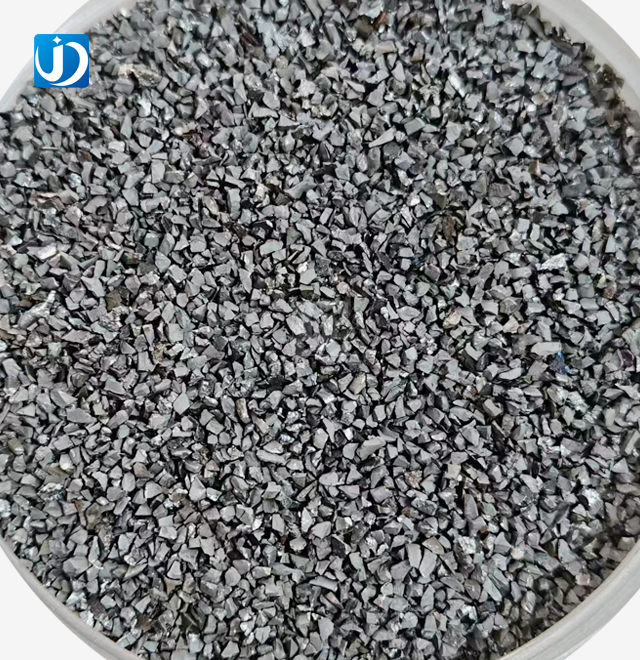
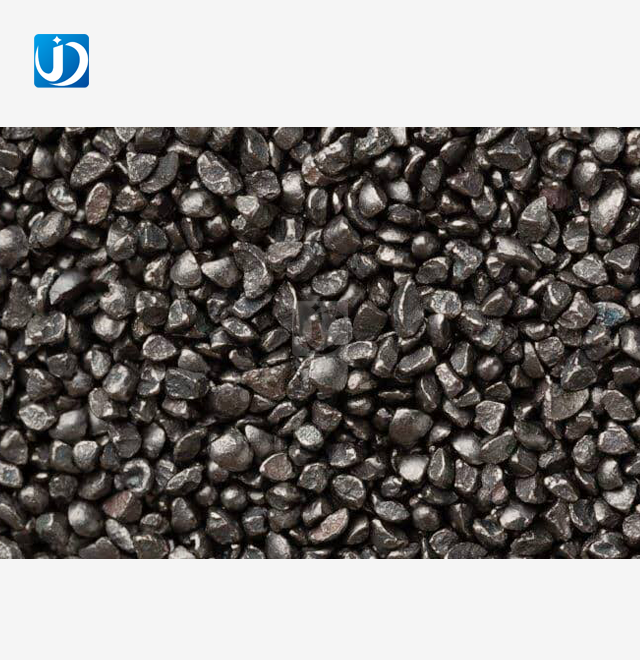
For blast cleaning, descaling, and shot peening, steel shot is a round metallic abrasive made from carbon or alloy steel. It's not steel grit, which is sharper and cuts more deeply. It's not mineral sand, glass beads, or aluminum oxide; those can't be reused in a wheel blast machine. Only metallic shot can.
There should be a list of the nominal size, hardness range, carbon content, and sphericity level for each batch. You can't buy anything without these four pieces of information on the packing slip. Trust doesn't show up on a month-end report of consumption.
Cast Steel Shot vs. Cut Wire Shot
To make cast steel shot, liquid steel is broken up into tiny particles that then harden into spheres. Drawn steel wire is used to make cut wire shot. The wire is cut into short cylinders and then rounded in a different process. When it comes straight from the factory, cast shot has a more even density, while cut wire shot can get very hard after being conditioned.
Cast shot in the S280–S330 range usually gives foundries the coverage and impact energy they need to clean castings with sand and scale embedded in them without leaving too much substrate marking.
Why Casting and Forging Plants Choose Steel Shot Over Mineral Media
Mineral abrasives are only used once before being thrown away. Steel shot is separated from broken pieces by air separation and screening before being put back into the blast cycle. Just that small difference can save a lot of money on abrasives over the course of a whole production year.
According to typical fatigue data from abrasive manufacturers and SAE testing protocols (SAE International, 2023), a single used steel shot particle can withstand between 3,000 and 5,000 impact cycles before it breaks beyond repair. Because mineral media doesn't have a second life like this, almost every wheel blast machine in a casting plant is built around a closed recovery loop.
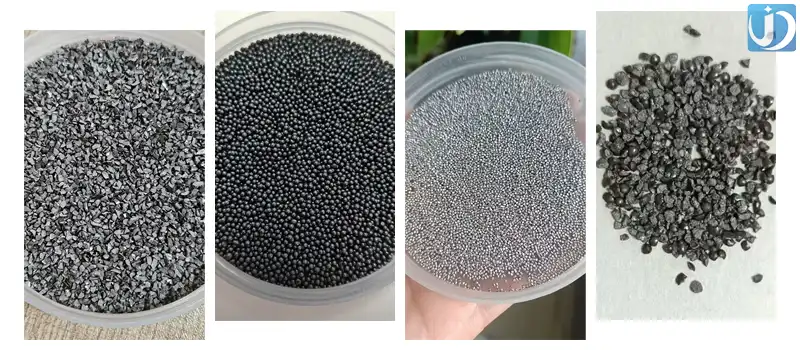
How Is Molten Steel Converted into Spherical Shot Through Atomization?Melting and Chemical Composition Control
The process starts in an electric or induction furnace, where scrap steel is melted and carbon, manganese, and silicon are added to change the chemistry. Before the melt gets to the atomizing station, the slag is skimmed off, the temperature is checked, and it is kept within a small pouring range.
A responsible mill keeps track of each batch's heat number, chemical make-up, and pouring temperature. On your order form, ask for this record. Not being able to get something from a supplier means you can't find out where a quality problem came from months later.
The Atomization Process Step by Step
It gets a steady flow of molten steel. A lot of the time, water or another stable fluid is used to split the steel while the pressure is set. Surface tension helps the molten steel droplets form spherical shapes. Before reaching the collection tank, each droplet cools rapidly and solidifies into a sphere, forming the basic shape of steel shot.
Several factors affect the outcome:.
- Pouring rate and stream pressure control droplet size, and a faster pour under higher pressure tends to produce smaller particles while a slower, lower-pressure pour yields larger shot suited for heavier descaling work.
- Melt temperature affects how long the steel stays fluid during the fall, and a melt that is too cool solidifies unevenly, creating tear-shaped or hollow particles that fail sphericity checks later in production.
- Nozzle geometry shapes the stream pattern, and worn or poorly maintained nozzles are a leading cause of inconsistent particle size between batches produced on the same line.
- Cooling conditions at the base of the atomizing tower determine whether particles solidify as clean spheres or fuse together into irregular clusters that get screened out as waste.
Atomization by itself doesn't mean that the product is finished. It only makes the rough shape that will be improved or thrown away by heat treatment and screening.
Initial Separation and Defect Removal
As soon as the raw materials are broken up into tiny pieces, they are put through magnetic separation and coarse screening to get rid of any big lumps, fused clusters, or obviously odd shapes. Before the batch moves on, hollow particles and satellites (small pieces stuck to a larger sphere) are seen and removed.
It goes like this: Melting → Composition control → Atomization → Quenching → Heat treatment → Screening → Cleaning → Testing → Packaging. Each arrow points to a step in the process where a defect might be found or missed, depending on how strict the mill's quality control is.
Why Are Steel Shots Quenched, Tempered, and Screened After Formation?
Quenching and Its Effect on Hardness
When you quench something, you quickly and carefully cool it down right after the particle forms or is heated up again. It makes the steel harder by locking it into a harder internal structure. But if you just quench the steel without doing anything else, the particle is often too fragile to be hit again and again.
Tempering for Toughness and Longer Service Life
When steel shot is tempered, it is heated to a lower, controlled temperature. This lowers the temperature inside the shot, reducing stress, and changing the final hardness. This is the step where toughness is built. If you temper a particle correctly, it won't break after thousands of impacts. If you temper it incorrectly, it will break after just a few hundred cycles, no matter how good the raw chemistry was.
It cuts through scale faster, but it also wears out your turbine blades faster. Shot with a moderate level of hardness lasts longer, but it may need more blast time on heavy rust.
Multi-Stage Screening and Size Classification
When particles are heated, they go through a set of vibrating screens that separate them into standard size grades. When screening isn't done right, the particles that are too big or too small mix together. This mix shows up on your parts as an uneven surface profile.
Most of the time, screening mistakes cause three problems:.
- Inconsistent surface profile, where some areas of a casting show a rough texture and others stay smooth, because the blast wheel is throwing mismatched particle sizes at the same surface.
- Excessive fines in the mix, which raise dust levels in your collection system and force more frequent filter changes than a properly screened batch would require.
- Unstable peening intensity, a serious issue for aerospace or automotive components where shot peening must deliver repeatable compressive stress across every part in the batch.
If the buyer checks both the nominal size label and the actual sieve analysis, most of these issues are taken care of before the material even gets to the hopper.
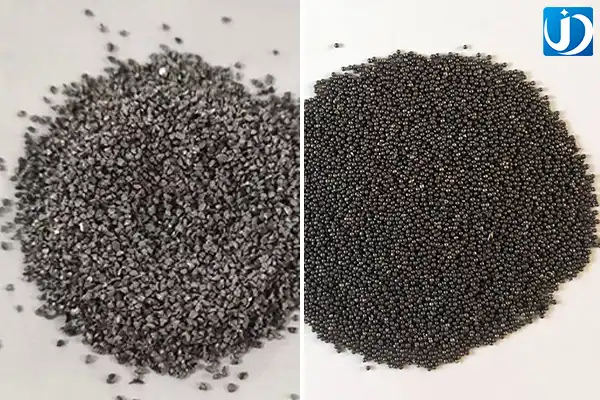
How Does Manufacturing Control Hardness and Microstructure for Consistent Performance?Hardness Ranges and Application Matching
There are two main types of commercial steel shot based on how hard they are. Shot for general use has an HRC of 40 to 50, which means it is tough and lasts longer when recycled. Shot that is very hard (HRC 55–62) cuts through heavy scale or hard coatings very quickly. You can't just compare a Rockwell C reading to a Vickers reading; you have to convert them first. That's why you should always ask the supplier what hardness scale and sampling method they used.
Microstructure, Toughness, and Fracture Behavior
How a particle reacts to repeated impacts is based on its internal grain structure, which in quality cast shot is usually a tempered martensitic structure. A structure that is dense and uniform doesn't crack easily. When there are holes or inclusions in a structure, it cracks easily, which leads to fines and higher consumption rates that you won't notice until the bag runs out faster than planned.
Case Data: What Changed When a Cangzhou Foundry Switched Supply
A mid-sized casting plant in Cangzhou used three wheel blast machines to make parts for engineering machinery. They kept track of how much abrasive they used for two full quarters in 2024. With its previous supplier, the company used an average of 0.28 kg per square meter and had a breakage rate of about 10% per recycling pass. When the plant switched to tempered S280/S330 steel shot with a fixed hardness specification, the process engineer saw that use dropped to 0.15 kg per square meter and breakage dropped to about 4%.
Over the course of a year, with that plant buying about 180 tons of steel shot every year, the change meant that 46% less steel shot was needed to clean the same area. The workshop supervisor at the plant said that readings of surface roughness became more consistent between shifts. This meant that fewer parts had to be sent back for rework. This is why the real cost per ton is based on hardness consistency and not just the number on the bag.
Steel Shot Hardness Guide
| Selection factor | Lower-hardness steel shot (HRC 40-50) | Higher-hardness steel shot (HRC 55-62) |
|---|---|---|
| Primary benefit | Toughness and longer recycling life | Faster cutting on heavy scale |
| Fracture tendency | Generally lower under repeated impact | Higher if tempering is poorly controlled |
| Typical use | Castings, general rust removal, repeated wheel blasting | Heavy mill scale, hard coatings, aggressive descaling |
| Main risk | Slower removal on stubborn contamination | Excess dust and faster turbine wear |
What Quality Tests Verify Sphericity and Size Distribution Before Shipment?
Dimensional and Shape Inspection
A good mill checks the particle size distribution, sphericity, satellite content, and the amount of over- or under-sized grains in the mix before sending out any lot. Tests that use sieves should use samples from more than one bag in the same lot, not just one scoop from the top of one bag.
Mechanical and Metallurgical Testing
The ability of a batch of steel shot to achieve its specified performance criteria is shown by a fatigue or breakdown test, a chemical analysis, a microstructure study and a hardness test. The provider has a dated report outlining test procedures and sample sizes, which is verified confirmation of quality, not simply marketing promises.
Quality Verification Checklist
| Verification item | Buyer question | Evidence to request |
|---|---|---|
| Size | Does the lot meet the specified SAE grade? | Sieve analysis report |
| Hardness | Is the value inside the agreed HRC range? | Rockwell hardness test report |
| Composition | Is chemistry consistent between lots? | Mill or batch certificate |
| Shape | Are irregular or hollow particles controlled? | Microscopy or shape inspection |
| Traceability | Can this lot be linked to production records? | Batch number and certificate of analysis |
| Packaging | Is the product protected during transport? | Packaging spec and load photos |
How Do SAE J444 Standards Classify Steel Shot Sizes Like S280 and S330?
SAE J444 Size Designations Explained
A lot of mills use SAE J444 to sort cast steel abrasive grain by size. It has grades from small S70 to large S550 (SAE International, 2023) as a guide. The number in each name refers to a certain sieve range, not to how hard something is. There should be a similar size spread between two bags labeled S280, but their hardness can be very different depending on how each mill tempered the batch.
S280 vs. S330: Choosing Between Two Common Grades
These are two of the grades that casting and valve factories want the most: S280 and S330. Along with having a slightly lower impact energy per particle, S280 is smaller and tends to cover a surface more evenly. S330 is often used for heavier scale on castings with thicker walls because it runs bigger and hits harder each time.
| Factor | S280 | S330 |
|---|---|---|
| Relative particle size | Smaller | Larger |
| Typical effect | Even coverage, moderate impact | Higher impact per particle |
| Common application | Valve bodies, auto parts, finer finishing | Engineering machinery parts, heavier castings |
| Selection note | May need more passes on heavy scale | Can leave a coarser surface profile |
You should never make your final choice based only on a size chart; you should always try it on your own parts first.
Standards and Documentation Buyers Should Request
Not only do international buyers use SAE J444, but they also sometimes use ISO 11124-3 (International Organization for Standardization, 2023) or DIN 8201 when a European customer needs it for high-carbon cast steel shot specifications. Before the first load leaves the yard, you should ask every new supplier for an analysis certificate, a technical data sheet, and a batch-level sieve report.
What Chemical Composition Differences Separate High-Hardness and General-Purpose Shot Grades?
High-Carbon and Low-Carbon Steel Chemistry
High-carbon steel shot, which usually has between 0.85% and 1.20% carbon, can be heated to higher temperatures and cuts better after being properly treated. Lower-carbon grades give up some of their hardness potential in exchange for more ductility, which can mean that they break less often during long-term recycling. The final microstructure of a material after tempering is also very important.
Alloying Elements and Their Function
Manganese makes the steel harder and helps it respond consistently to being cooled. Silicon helps with deoxidation while it melts and changes how the finished particle behaves mechanically. When used, small amounts of chromium can make materials even harder and less likely to wear down. It's much more useful to look at a specification sheet with actual chemistry ranges than a label that just says "premium grade."
Chemical Compliance and Safety Documentation
Buyers who are exporting and plants that supply regulated industries should ask for a Safety Data Sheet that is specific to their market. As per the European Chemicals Agency (2023), shipments going through the EU may need to be registered under REACH depending on the amount and type of substances they contain. Occupational Safety and Health Administration (2023) says that buyers in the United States should make sure that the supplier's paperwork follows OSHA's Hazard Communication Standard for workplace labeling and exposure information.
How Does Manufacturing Quality Affect Breakage Rate and Dust Generation on the Shop Floor?
Common Causes of Premature Steel Shot Breakdown
A number of manufacturing shortfalls show up later as too much broken stuff on the shop floor. Particles that are too hard or not well tempered break on impact. When you atomize something quickly, it creates internal porosity that hides weak spots that you can't see until the particle breaks in the middle of its cycle. Inadequate screening leads to a range of sizes on your blast wheel, which leads to uneven wear. This shortens the life of both the abrasive and the machine.
Dust, Fines, and Workplace Controls
Broken steel shot turns into fine dust that moves through your recovery system and into the air in your workshop. A dust spike doesn't always mean bad shot, but it's always a good idea to check. Dust comes from the rust, scale, and coating that is being removed as well as the abrasive itself.
Controls that can be used to lower exposure include good ventilation and dust collection tools, blasting cabinets with doors when possible, and regularly cleaning the fines off of the recovery screen. The EPA has found that abrasive blasting is a major source of particulate emissions that need to be controlled for collection in industrial settings (U.S. Environmental Protection Agency, 2022), which is something you should talk about with your safety officer when you review your equipment once a year.
Calculating True Cost of Use, Not Just Purchase Price
A lower price per ton may actually cost more when you add up how often you have to restock, how long it takes to clean recovery screens that get clogged, and how much time you spend trying to get consistent surface results. When purchasing managers compare two suppliers based only on price per ton, without also looking at breakage rate and consumption per square meter, they often sign a contract that they later wish they hadn't.
High-Hardness vs. General-Purpose Steel Shot: Which Fits Your Application?
Comparative Decision Table
| Selection criterion | General-purpose (HRC 40-50) | High-hardness (HRC 55-62) |
|---|---|---|
| Typical strength | Toughness, longer cycle life | Higher hardness, faster cutting |
| Fracture risk | Lower under repeated impact | Higher if tempering is uneven |
| Cleaning aggressiveness | Suited to routine descaling | Suited to heavy scale or hard coatings |
| Typical industry | Casting, forging, general fabrication | Heavy equipment, structural steel prep |
| Verification priority | Fatigue life, breakage rate | Hardness consistency, fracture rate |
Three Real-World Application Scenarios
In the industries where most of my clients work, steel shot selection typically depends on the application and the surface finish required:
- Automotive casting plants running wheel blast machines on engine blocks and transmission housings generally lean toward S280-grade general-purpose shot around HRC 40-50, balancing scale removal with dimensional protection on precision-machined surfaces.
- Valve manufacturers cleaning cast bodies before painting often select mid-range hardness paired with careful size control, since valve surfaces need a consistent roughness profile for coating adhesion without leaving pitting that affects pressure testing.
- Engineering machinery plants cleaning heavy, thick-walled castings frequently move to S330 or higher-hardness grades, since thicker scale on larger parts needs more impact energy per particle to clean efficiently within a reasonable cycle time.
Most plants can control how much they spend on abrasives every year by matching the grade to the part instead of going with what the supplier suggests.
Steel Shot Compared with Steel Grit and Other Media
| Media | Main strength | Main limitation | Typical fit |
|---|---|---|---|
| Steel shot | Reusable, rounded impact, lower dust than disposables | Needs a working recovery system | Wheel blasting, cleaning, peening |
| Steel grit | Angular, aggressive cutting | Breaks down faster, rougher profile | Heavy scale and coating removal |
| Glass beads | Gentle, decorative finish | Limited durability for heavy cleaning | Light finishing work |
| Aluminum oxide | High cutting power | Usually disposable, higher consumption | Aggressive one-pass preparation |
How Should a Foundry Evaluate a Steel Shot Manufacturer Before Signing an Annual Contract?
Supplier Capability Checklist
Before you sign a framework agreement with a supplier, I suggest you check them against a short list of production basics:.
- Process control over atomization and heat treatment, since this is the single biggest factor separating a consistent batch from a mixed one, and a supplier who cannot describe their quenching and tempering parameters likely has not standardized them.
- Laboratory testing capability on-site, including hardness checks and sieve analysis, rather than outsourced testing that adds days to every quality dispute you might raise.
- Batch traceability, so a quality issue three months from now can be traced back to a specific heat number instead of becoming an unresolved argument.
- Packaging and delivery track record, particularly whether the supplier reliably ships in 25 kg woven bags for manual handling or 1000 kg ton bags sized around 1000 x 1000 x 1200 mm for automatic feed systems.
Botou Junda Machinery, which is based in Hebei's foundry equipment manufacturing base, sells S280/S330 cast steel shot that is in line with SAE J444. It comes in two hardness ranges and twelve particle size grades, ranging from 0.2 mm to 3.0 mm. The company's shot is made with a dense, tempered microstructure that is meant to keep it from breaking. It has a rated recycling life of 3,000 to 5,000 impact cycles and usually uses between 0.1 and 0.3 kg per square meter, depending on the level of contamination and how the equipment is set up.
Procurement Checklist for Bulk Orders
Before you place your order, write down the SAE grade, size range, hardness range, and chemical make-up that you need. Find out how much you need to keep on hand, how long it takes to make, and at least how many you need to order before you place your order. Do you need 25 kg bags or ton bags to move by hand? Pick a way to pay, talk about the warranty, and pick who will deliver the first package before the package leaves the factory.
Pre-Shipment and Receiving Inspection
Before the whole thing is made, ask that a reference sample be kept. Not just the bag on top of the package should be opened and checked when you get it. Check all of the bags inside as well. Take pictures and write down the lot numbers of any changes in weight, hardness, or contamination that you can see before the material goes into the hopper. If you ever need to make a replacement claim, this record will keep you safe.
Common Supplier Risks and Mitigation
| Risk | Potential consequence | Mitigation |
|---|---|---|
| Incorrect size mix | Uneven finish, unstable process parameters | Require sieve analysis on every lot |
| Uncontrolled hardness | Fracture, substrate marking, slow cleaning | Specify HRC range and test method in the contract |
| Weak traceability | Difficult quality claims, repeat disputes | Require batch numbers and certificates on delivery |
| Poor packaging | Moisture damage, weight loss in transit | Approve bag and pallet standards before shipment |
| Price-only comparison | Hidden cost from breakage and downtime | Compare cost per ton cleaned, not price per ton bought |
Conclusion
There are several steps that each piece of steel shot must go through before it can be put on the blast wheel. These steps change different parts of the final product. For example, when you cut something into little pieces, each batch is different in size, shape, and hardness.
The best grade for a plant that goes through tons of abrasive every month depends on the substrate, the level of contamination, and the recovery system. It doesn't matter which supplier comes up first on a 1688 search. Separately ask for hardness and size information, ask for real test records, and judge suppliers based on how consistent their lots are rather than how much they charge on a single invoice.
FAQ
What is steel shot used for?
Cleaning, descaling, rust removal, deburring, surface preparation, casting cleanup, and shot peening are all done with steel shot. It goes through wheel blast machines in foundries, auto parts factories, and shops that work with structural steel. For smaller parts, it also goes through some air-blast systems.
How is steel shot manufactured?
It is used to break up molten steel into droplets, which then cool down and form round particles. After that, the particles are cooled, tempered, cleaned, screened into size classes, tested for hardness and composition, and then put in boxes ready to be shipped.
What is the difference between S280 and S330 steel shot?
In SAE J444, sizes S280 and S330 are different; S330 is bigger than S280. The best size particles depend on the target's scale thickness and finish. Larger particles hit harder, but smaller particles cover the ground more evenly.
How long does steel shot last before it needs replacing?
Quality cast steel shot can usually withstand between 3,000 and 5,000 impact cycles before breaking beyond repair. However, the actual life depends on how hard the steel shot is, how the machine is set up, and how well the screening and air separation system removes broken particles from the working mix.
Why does my steel shot consumption keep rising even though I haven't changed suppliers?
A rise in consumption is often a sign of a drop in batch quality, worn-out screening equipment in your recovery system, or a change in the amount of contamination in the parts. Usually, you can tell which factor changed first by doing a new sieve analysis and hardness check on your stock.
What documents should accompany a steel shot shipment?
A technical data sheet, certificate of analysis, sieve analysis, hardness report, chemical composition, batch number, and packing list should all be part of a full shipment. Exports may also need a Safety Data Sheet that meets the needs of the country where the goods are going.
A Quick Note Before You Place Your Next Order
I know how hard it is to keep a production line going when each ton of abrasive has to work the same way as the last. Junda Machinery sells SAE J444-compliant S280/S330 steel shot in twelve different particle size grades. The steel shot is tested for hardness and sieve accuracy at the batch level and comes in either 25 kg bags or 1000 kg ton bags, depending on how your line is set up. If you are looking for a steel shot supplier for your next framework agreement, please email our technical team at junda001@jundablast.com with information about how much steel shot you use now, and we will send you a matching specification sheet within one business day.
References
SAE International. "SAE J444: Cast Shot and Grit Size Specifications" (2023). Used to define steel shot size grades including S280 and S330.
International Organization for Standardization. "ISO 11124-3: Specifications for Metallic Blast-Cleaning Abrasives — High-Carbon Cast-Steel Shot and Grit" (2023). Referenced for international steel shot specification standards.
European Chemicals Agency. "REACH Regulation: Registration, Evaluation, Authorisation and Restriction of Chemicals" (2023). Referenced for EU chemical compliance obligations on exported abrasive media.
Occupational Safety and Health Administration. "Hazard Communication Standard" (2023). Referenced for workplace labeling and exposure documentation requirements.
U.S. Environmental Protection Agency. "AP-42: Compilation of Air Emissions Factors, Chapter 13.2.6 Abrasive Blasting" (2022). Referenced for dust and particulate emission considerations in blasting operations.
SSPC: The Society for Protective Coatings. "Surface Preparation Standards" (2023). Referenced for surface cleanliness benchmarks used alongside steel shot blasting.
About the Author
Michael Wang is a Shot Blasting Media Specialist with field experience supporting foundries, forging plants, and export traders across China's casting industry clusters. He works directly with production teams on hardness selection, consumption analysis, and recovery system troubleshooting, and he regularly reviews mill-level test data to help buyers compare suppliers on measurable performance rather than price alone.

USER EVALUATE
Real feedback and practical experience shared by worldwide partners who purchased our machinery and environmental treatment devices.