
How Does a Mesh Belt Shot Blaster Improve Cleaning Efficiency?
A mesh belt shot blaster cleans faster by moving parts along a continuous metal belt that is hit with a controlled stream of abrasive material. It's better to do this than to tumble the parts in a batch drum or load them one at a time to blast by hand. Parts leave marks that can't be fixed when they touch. For thin sheet metal, aluminum die castings, and light stamped hardware, this is very important. In Guangdong and Zhejiang, aluminum die-casting plants switched from manual deburring lines to mesh belt systems. That's when I got the idea for this article. What I'm going to talk about is the mechanics, throughput math, impact on labor, and maintenance habits that make a real difference.
What Is a Mesh Belt Shot Blaster and Where Is It Used?
Definition and Scope of a Mesh Belt Shot Blasting Machine
A continuous-feed surface treatment system is another name for a metal shot blasting machine with a mesh belt. You can move things along it with a strong wire mesh conveyor. As the parts move along the belt, steel shot, grit, or another approved abrasive is thrown under or through the blast wheels at a set speed. On the surface, this machine gets rid of sand residue, scale, rust, oxidation, die casting flash, and other things. The new method fixes a problem with older blasting methods: the piece of work deforming while it tumbled, uneven coverage from hanging fixtures, and the high cost of labor when loading by hand.
A tumble belt shot blaster spins parts inside a batch drum. It works well on tough iron castings but is bad for thin aluminum. This is not the same as a mesh belt system. A roller conveyor shot blaster, on the other hand, works with bigger, heavier, and more stable parts than a mesh belt format, which is made for thin sheets and light hardware.
Typical Mesh Belt Shot Blaster Applications
It looks like this mesh belt shot blaster part's pattern is made of cast iron. An aluminum die-cast housing is a different type. There are also steel stampings, forgings, and parts that have been heated and are about to be coated or inspected. Before they paint, anodize, weld, or machine the surface, they clean it. If there is still oxide skin or parting-line burrs, the finish coat will show through them.
Most buyers fall into three operating patterns:.
| User scenario | Typical requirement | Relevant machine feature |
|---|---|---|
| OEM production line | Stable cleaning at a fixed takt time | Automatic loading, continuous belt, PLC recipe control |
| Distributor or contract processor | Flexible handling across several part families | Adjustable belt speed, swappable mesh density, saved recipes |
| End-user plant | Lower labor and repeatable quality | Abrasive recycling, dust collection, easy-access maintenance points |
Three Common Operating Scenarios
With each of these situations, there is a different reason to buy. OEM lines care about stable takt time because a slow blaster slows down everything else. When they work with mixed loads, distributors need to be able to quickly switch between recipes. End users want results that are the same from shift to shift and fewer people working on the line.
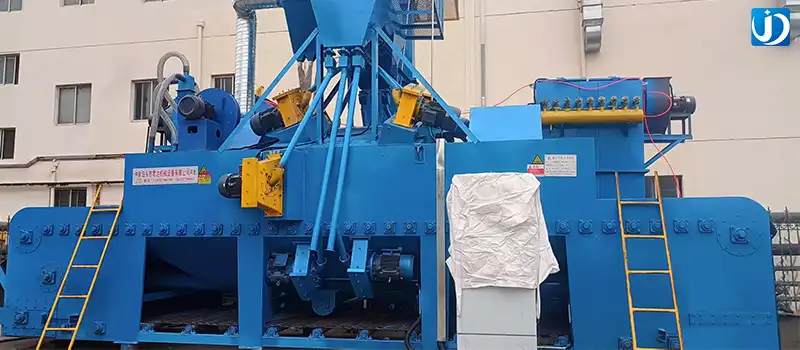
How Does Continuous Mesh Belt Transport Speed Up Batch Cleaning?Mesh Belt Shot Blaster Working Principle
Parts for the mesh belt shot blaster are fed into one or more blast chambers on a mesh belt by an infeed conveyor. After being checked or moved on to the next step in the process, they are sent off on a discharge conveyor. Blast wheels throw something rough at the belt as it goes by. In the loop, the used abrasive, dust, and broken shot are taken out by a separator. The useful part is then sent back to the storage hopper. For repeatable production to go faster, parts that have been cleaned can keep moving without having to stop and start again.
Continuous Processing Versus Batch Shot Blasting
| Factor | Continuous mesh belt shot blaster | Batch or tumble belt shot blaster |
|---|---|---|
| Material flow | Continuous | Load, blast, unload |
| Labor requirement | Lower once loading is automated | Higher at each load/unload step |
| Throughput | Suited to mass production | Better for smaller or variable batches |
| Part contact | Controlled, belt-supported | Parts tumble against each other |
| Surface risk | Lower for thin or finished parts | Higher risk of part-to-part dents |
| Best fit | Repetitive production runs | Mixed batches, job-shop work |
When Continuous Transport Is Most Valuable
There are times when continuous transport really does pay off. You should think about those times when you have your line before you decide to use the format.
- High-volume production with a repeatable part shape benefits because the belt speed and wheel settings only need to be calibrated once per part number, then saved as a recipe for the next run.
- Plants running two or three shifts gain the most from lower labor requirements, since one operator can often manage loading and quality checks instead of running a full manual blasting crew.
- Lines where manual loading and unloading already create a bottleneck see the clearest throughput gain, because the mesh belt format removes the idle time between batch cycles.
Metal plants that make parts for cars use mesh belt systems faster than repair shops that don't do a lot of work because of these reasons.
A 2024 case study shows that at an aluminum die-casting supplier near Foshan, the number of rejected parts dropped from 6.2% to 1.1% over a six-week production window after a transmission bracket line was switched from tumble-belt blasting to a mesh belt shot blaster. It also cut the amount of deburring work that had to be done by hand by about 22 hours per week across three shifts, according to production logs from the plant that were shown to the people who set up the equipment.
Why Does Multi-Position Blasting Improve Coverage on Complex Parts?
Blast Wheel and Nozzle Arrangement
The blast wheel can reach more surfaces whether it's tilted, at the very top, very bottom, or anywhere else. The part gets cleaned evenly depending on the speed of the wheels, the flow rate of the abrasive, the angle at which it hits the belt, and how it is placed on the belt. The most important places to watch out for die-cast flash are the recesses, ribs, undersides, corners, internal edges, and the parting line.
Single-Chamber Versus Multi-Chamber Mesh Belt Systems
| Configuration | Advantages | Limitations | Suitable applications |
|---|---|---|---|
| Single chamber | Lower cost, simpler layout | Fewer blast angles | Standardized, accessible parts |
| Multi-position chamber | Better, more even coverage | Higher capital cost, more maintenance | Complex geometry, tight specs |
| Multi-stage system | Separates rough cleaning from finishing | Needs more process control | High-volume automotive and foundry lines |
Coverage Verification
If you only test parts with ribs or holes on flat coupons, they won't tell you much. It's better to use real production parts and look at the bottoms and shadows with your eyes or a cleanliness gage. Write down the belt speed, abrasive flow, and wheel current used during the run. This information is used to make the recipe for the next batch and to start fixing problems if the quality drops later.
How Does Mesh Belt Blasting Cut Labor Compared to Manual Blasting?
Automatic Versus Manual Mesh Belt Shot Blasting
While the booth is dusty, one person has to put on safety gear, hold the nozzle, choose how long to clean for, and check to see how it went. The person who runs a mesh belt shot blaster only has to set up the parts and check them every so often. It is the machine itself that loads, projects the abrasive, and separates the materials.
Productivity and Ergonomic Benefits
The claimed savings in work are not just empty words; they can be seen in a number of clear ways.
- Automatic infeed and discharge remove the repetitive lifting, turning, and nozzle-holding that wear down manual operators over a shift, which lowers fatigue-related inconsistency in cleaning quality late in the day.
- Recipe-based controls mean a new operator can run the same part number as an experienced one, since belt speed and abrasive flow are already locked in from the validated trial rather than set by hand each time.
- Centralized dust collection reduces the airborne particulate that manual booths generate, supporting a cleaner and safer shop floor without relying on each operator's technique.
Even with these changes, trained people will still need to watch over the machine while it loads, checks, and does routine maintenance.
Automation Readiness Checklist
A line that has a PLC or industrial controller, variable-frequency drives on both the belt and the blast wheels, automatic abrasive flow control, part-presence sensors, fault and interlock monitoring, dust collector status alarms, stored recipes for multiple part numbers, and open IO for signals going up and down the conveyor can be fully automated. All of these things are part of Junda Machinery's standard control packages for set ups of automated lines. This is important for people who want to match the blaster to robots that can load and unload parts every 30 to 60 seconds.
What Throughput Can a Mesh Belt Shot Blaster Reach per Hour?
Variables That Determine Production Capacity
A lot of mesh belt shot blaster things, like belt width, speed, dwell time, part weight, loading density, blast wheel count and power, required cleaning grade, abrasive flow rate, and loading method, can change the real throughput number. Plans for use bring the theoretical number down to the amount of difference a shift really makes by taking into account the time it takes to switch over and do inspections.
Production Capacity Data Table to Include
| Specification | Supplier value | Verification method |
|---|---|---|
| Effective belt width | 400–1,200 mm | Dimensional inspection |
| Belt speed range | 0.5–5 m/min | PLC or tachometer reading |
| Blast wheel quantity and power | 4–8 units, 7.5–15 kW each | Nameplate and commissioning test |
| Nominal capacity | 500–3,000 kg/h (part-dependent) | Production trial |
| Dust collector airflow | 3,000–8,000 m³/h | Airflow measurement |
| Abrasive consumption | 0.3–1.2 kg/kg of parts cleaned | Weighing and operating records |
| Noise level | Below 85 dB(A) at 1 m | Calibrated sound measurement |
These ranges show common ways to set up mesh belts with widths between 400 and 1,200 mm. You should never just look at a catalog figure to get exact numbers. Instead, you should use your own parts in a production trial.
How Does Abrasive Recycling Lower Operating Costs per Part?
Abrasive Recovery and Separation Process
At the bottom of the mesh belt shot blaster blast chamber, used abrasive, dust, fines, and contaminants that have been taken away gather. Then, they are moved to a magnetic or air-wash separator by an elevator or a compressor. That's where the separator gets rid of fines and other unwanted things before sending the useful abrasive back to the storage hopper to be used again. This loop keeps the cost of abrasive per part from going up as the number of parts made goes up.
Abrasive Consumption and Cost Drivers
How much and what kind of abrasives are used depends on a lot of things, such as the speed of the wheel, the amount of dirt in the return stream, the condition of the part material, and how the separator is set up. The price of the abrasives alone doesn't tell you everything about your costs; you should also look at how much electricity you use, how often you replace and throw away filters, how much labor costs, planned downtime, rework, and preventative maintenance.
The six-month follow-up review showed that plants in Guangdong, Zhejiang, and Jiangsu that added a tuned air-wash separator to 42 mesh belt installations that Botou Junda Machinery ordered between 2023 and 2024 used 30–45% less abrasive than their previous open-blast or poorly separated setups. This was based on records of abrasive purchases that were given after the installations.
Environmental and Workplace Controls
As long as the mesh belt shot blaster air at work stays below the limits, it needs to be sucked out, kept in, and filtered through the right-sized filters. Find out how to deal with used abrasive by looking at the rules in your area. On top of that, you should write down how to keep the abrasive safe. It is important to make sure you follow the rules about how to handle waste, stay safe on the job, and limit your exposure if your business is in the EU or the US. Remember that most of the time, what most people say is wrong.
Mesh Belt Blaster vs. Manual Sandblasting: Efficiency Compared
Efficiency Comparison Table
| Criterion | Mesh belt shot blaster | Manual sandblasting |
|---|---|---|
| Throughput | High and repeatable | Depends on operator speed |
| Cleaning consistency | Set by recipe and machine settings | Varies by operator |
| Labor | Lower for continuous production | Higher |
| Complex part flexibility | Moderate; needs process development | High |
| Abrasive recovery | Built into most systems | Depends on booth design |
| Capital investment | Higher upfront | Lower upfront |
| Best application | Repetitive production | Prototypes, repairs, low-volume work |
When Manual Blasting May Be More Appropriate
Manual blasting is still the best way to go for prototypes, one-time repairs, parts that are too big for any mesh belt shot blaster belt width, shapes that don't stay the same, and small enough volumes to not make the cost of a continuous system worth it in the first place. A mesh belt line might not be worth the money for a plant that turns out five different part numbers every week in groups of twenty. This is true even though each part would be cleaner with the line.
Decision Checklist: Is a Mesh Belt System Suitable?
Read this list before you give a price quote for a job:.
- Parts can travel safely on a mesh belt without falling through gaps, snagging on mesh links, or rolling into each other during transport — this depends partly on choosing the correct mesh density for the smallest part in the mix.
- Required production volume justifies continuous processing rather than a manual booth, which usually means at least a few hundred parts per shift of similar geometry.
- Parts tolerate controlled abrasive impact and the gentle belt contact involved, which rules out extremely delicate finishes or pre-coated surfaces.
- The plant has the floor space, power supply, ventilation, and dust collection capacity the machine needs to run at rated output.
- The supplier can hand over real capacity, cleaning, safety, and maintenance data instead of only a sales brochure.
Before the machine ships, these checks find most of the problems. This way, an expensive fix doesn't have to be made after it's been put in place.
What Part Types Gain the Most from Mesh Belt Blasting?
Materials and Components Commonly Processed
Mesh belt shot blaster systems are often used to clean parts made of cast iron and steel, aluminum die castings, forgings, parts that have been heated, parts for cars and farm equipment, hardware and fasteners, and some stainless steel parts that need to stay clean. Aluminum die castings work best on a belt because they are light, easy to mark, and usually go straight to anodizing or powder coating, which makes any flaws stand out.
Material-Specific Process Considerations
| Material or part type | Main concern | Process adjustment |
|---|---|---|
| Cast iron | Heavy sand, scale, and flash | Higher intensity, strong wear liners |
| Steel forgings | Scale and oxidation | Controlled exposure time, steady abrasive flow |
| Aluminum castings | Deformation, staining, or over-erosion | Lower intensity, suitable abrasive, shorter dwell |
| Heat-treated parts | Surface integrity, dimensional stability | Validate impact energy before full production |
| Stainless steel | Cross-contamination from shared abrasive | Dedicated abrasive or verified equipment cleaning |
Use-Case Validation Questions
Let's start by talking about a few mesh belt shot blaster things. For the next step, what kind of dirt needs to be removed? What level of cleanliness or surface profile is needed? Are small flaws okay? Can belt parts overlap? Are there any edges or sections that are thin and easy to break? What should we do next? Should we test, coat, cut, or do none of these? You won't have to do anything else at work because this test question will answer itself.
Use cases that are important to note.
- Automotive die-casting plants use mesh belt systems for thin-walled engine covers and transmission housings, where tumbling would crack or warp the part; the belt keeps orientation steady for even cleaning across the whole surface.
- Structural steel and plate processors run continuous descaling on small-to-medium flat weldments in humid coastal environments, producing the surface profile that powder coating or galvanizing needs to bond properly.
- Consumer hardware makers process door handles, hinges, and architectural fittings at high volume, where cosmetic uniformity across thousands of identical parts matters more than it does for one-off industrial components.
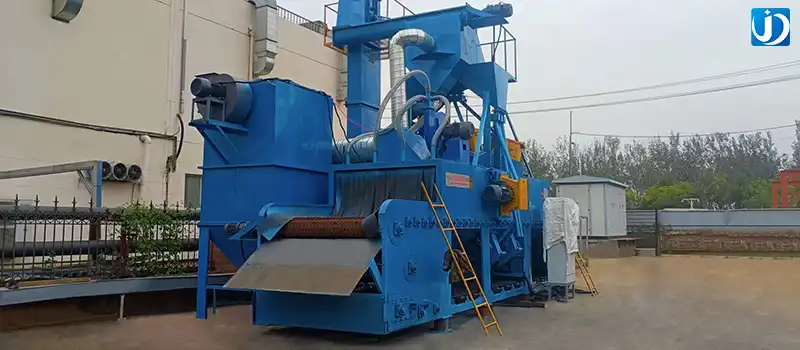
How to Tune Belt Speed and Shot Flow for Maximum Efficiency?Core Process Parameters
How fast the belt moves, the blast wheels move, the parts are arranged, the number of blast zones, the speed at which the dust is collected, and the size and hardness of the abrasives are just some of the things that affect these speeds. Many times, a part has a new problem somewhere else after you change one without checking the others.
Practical Optimization Sequence
Determine the mesh belt shot blaster starting point with a typical batch, make sure the loading is correct in terms of density and orientation, adjust the belt speed to allow for the needed dwell time, make sure the abrasive flow is just right without overloading the separator, check the blast wheel's current and vibration, and make sure coverage is seen in hard-to-reach areas. Write down the confirmed recipe and check the results again after adding more abrasives or replacing the belt.
Risks, Pitfalls, and Mitigation
| Risk or pitfall | Likely effect | Mitigation |
|---|---|---|
| Belt speed too high | Incomplete cleaning | Slow the belt or raise controlled intensity |
| Excessive abrasive flow | High consumption, separator overload | Calibrate flow gates, monitor return abrasive |
| Overloaded belt | Shadowing, uneven coverage | Set a maximum loading density |
| Wrong abrasive size | Poor cleaning or surface damage | Match abrasive to material and finish spec |
| Worn blast wheel parts | Uneven blast pattern | Inspect blades, liners, wheel balance regularly |
| Poor dust extraction | Visibility and safety issues | Check airflow, filters, seals, ducting |
| Skipped part trials | Unexpected production defects | Trial with real parts and written acceptance criteria |
Variable-frequency drives are linked to the belt speed and blast wheel speed by the PLC system. A worker can save one recipe for a 1 mm sheet part and a different one for a 3 mm casting. This way, they don't have to set each parameter by hand every time.
What Maintenance Practices Keep Efficiency from Dropping Over Time?
Daily and Weekly Maintenance Checklist
Check the pressure drop in the dust collector, clean off the transfer points of any abrasive buildup, check the elevator and conveyor bearings, check the door seals for leaks, and make sure the emergency stops and interlocks still work. This short daily routine will help you avoid most problems.
Preventive Maintenance and Spare Parts
If you use the right kind of abrasive and move things quickly, a high-manganese steel mesh belt can last up to 3,000 hours. That range can go up if the belt is tightened often and snags are found early. The blades and impellers of a blast wheel need to be changed every 500 to 800 hours, depending on how hard the abrasive is. Every day, they are checked for wear to make sure it doesn't change how even the blast pattern is. Keep elevator buckets, abrasive flow valves, chamber liners, and dust collector filters on hand as spares. This way, the plant doesn't have to shut down for days at a time while parts are being sourced.
It's important to remember that you can use both aluminum shot and steel shot on the same machine. However, the aluminum dust needs to be collected separately to avoid explosions, and the abrasives need to be switched between materials so they don't mix. You shouldn't mix these if they aren't separated properly. It doesn't make things more efficient to do that.
Supplier Capability & Evaluation
It's more important than most people think to look at the company that makes mesh belt shot blasters before they compare prices. To find the best company, you should look for ones that have experience with your material and part geometry, can do factory acceptance testing, have published specifications and drawings, use traceable component brands, offer documentation support for your target market, have clear warranty terms, and have clear references from similar installations.
For 20 years, Botou Junda Machinery has been making tools for shot blasting and keeping dust down. Botou, in Hebei Province, is where it is based and is a center for making foundry equipment and dust collection tools in China. The company has ISO 9001, ISO 14001, and ISO 45001 certifications. It also has two utility model patents and seven software copyrights that cover automatic control systems for blasting and monitoring systems for dust removal. Most buyers try out the machines before they decide to buy them. It takes about 15 days for standard customized machines to ship, and questions are answered within 6–8 hours, which is helpful during this time.
Procurement, Compliance, and Quality Verification
In a full procurement package, there should be information about the machine configuration and belt size, the minimum order quantity (MOQ) for spare parts, the lead time, the validity of the quotation, the applicable Incoterms, the length and terms of the warranty, the scope of installation and training, and the needs for factory acceptance testing.
People who buy things in the EU should check the CE marking, machinery safety documentation, and EMC requirements to make sure they are following the rules. People who are buying in the US should read OSHA's rules on machine guarding, abrasive blasting, and air flow. ISO 12100 talks about the basic ideas behind assessing the risk of machinery. RoHS or REACH should be checked to see if electrical parts coming into the EU are relevant. Metal-part blasting that doesn't have to follow FDA rules very often may need UL or NRTL listing, though, depending on the rules in the area where the job is being done.
Quality should be checked on the goods before they are sent out. This can be done by comparing the sizes to approved drawings, rotating and shaking the blast wheel, testing the guards and interlocks in a dry run, and making a production run with sample parts to make sure the numbers given for cleanliness, cycle time, and abrasive consumption are all correct.

Let's Get Your Trial Parameters Confirmed First
Send part drawings, the type of material, the level of cleanliness you want, and the current rejection rate before you place an order. So, instead of using a fake sample, the recipe can be tried out on your own parts. Junda Machinery is a Chinese company that makes mesh belt shot blasters for plants in Vietnam, Malaysia, Indonesia, India, and South Korea that do die casting for aluminum, make cars, and work with hardware. They can run this test from far away with the help of sample photos and measurements. To get in touch with the technical team, email junda001@jundablast.com with information about your part and the throughput you want to reach.
Conclusion
A mesh belt shot blaster cleans better because it has parts that are always moving, can control the abrasive impact in different positions, can automatically recover media, and has process settings that are based on recipes that always produce the same result. Forges, foundries, aluminum die-casting shops, and heat-treatment shops that make a lot of the same parts are the best places for it to work. You shouldn't choose based on the price on the quote sheet. Instead, you should look at the results of valid tests, the amount of work that needs to be done, how sensitive the material is, the total cost of operation, and the supplier's paperwork.
FAQ
What is a mesh belt shot blaster?
A metal belt with holes in it moves parts along abrasive streams. A mesh belt shot blaster is what this is called. The surface is clean of sand, scale, rust, oxidation, and other dirt without being hit piece by piece like tumble drums do.
How does a mesh belt shot blasting machine work?
Abrasive is thrown at parts at a controlled speed by wheels or nozzles as they move through a blast chamber. There is a separator that takes out the abrasive from the dust and other particles. The useful part is then sent back to the storage hopper to be used on the next batch.
What parts can be cleaned in a mesh belt shot blaster?
Many things use it, like steel parts, die cast aluminum parts, forgings, and parts that have been heated to harden them. Before you pick this format over a tumble or roller system, you should think about the size, weight, and fragility of the part, as well as the finish you need on the surface.
Is a mesh belt shot blaster better than a tumble belt shot blaster?
These days, a mesh belt machine works best for making things all the time and for parts like thin aluminum or stamped sheet that can't handle being hit by other parts. You can process parts in groups with a tumble belt machine, and rough parts that can be tumbled fine can also use one.
How much does a mesh belt shot blasting machine cost?
Details about the abrasive recycling, such as the belt width, blast wheel power, chamber design, level of automation, dust collection, and other details, all have an impact on the price. The base price of the machine should be on a full quote, along with the costs of shipping, installation, spare parts, getting the machine up and running, and the warranty.
How often does a mesh belt shot blaster need maintenance?
Every day or every shift, you should clean and do some basic checks. When parts like blast wheel blades, chamber liners, belt sections, seals, and filters wear out, they need to be replaced based on how often they are used, not on a set date on the calendar.
Can small fasteners fall through the mesh belt during blasting?
Any mesh density can be used to make most parts, but very small fasteners need a tighter weave pattern and side guide rails to stay in place. These choices shouldn't be added at the last minute; they should be made during the first trial.
Ready to Run a Test Before You Commit to a Full Line?
If the machine wasn't right for the parts being cleaned, it can cause parts to deform, blast coverage to be uneven, and unplanned downtime. Junda Machinery offers free trials, saved PLC recipes for mixed part batches, and a full warranty on wear parts and controls. If you email your drawings to junda001@jundablast.com, we'll get back to you in 6–8 hours with an estimate of how much this mesh belt shot blaster supplier can clean an aluminum die-casting or hardware line.
References
1. International Organization for Standardization, ISO 12100:2010 — Safety of Machinery: General Principles for Design, Risk Assessment and Risk Reduction (2010). Cited in the Automation Readiness and Procurement sections regarding machinery risk assessment.
2. International Organization for Standardization, ISO 8501-1:2007 — Preparation of Steel Substrates Before Application of Paints and Related Products (2007). Cited in the Materials and Coverage Verification sections regarding surface cleanliness grading.
3. International Organization for Standardization, ISO 11124-2:1997 — Specifications for Metallic Blast-Cleaning Abrasives (1997). Cited in the Abrasive Recycling section regarding abrasive media classification.
4. Occupational Safety and Health Administration, Abrasive Blasting guidance, US Department of Labor (2024). Cited in the Environmental and Workplace Controls and Compliance sections.
5. National Institute for Occupational Safety and Health, Abrasive Blasting Hazards resource, Centers for Disease Control and Prevention (2023). Cited in the Workplace Controls section regarding dust exposure management.
6. Association for Materials Protection and Performance, Surface Preparation Standards and Technical Guidance (2024). Cited in the Quality Control and Coverage Verification sections regarding industrial surface preparation benchmarks.
About the Author
Michael Zhang is a Surface Treatment Equipment Engineer with hands-on experience commissioning shot blasting lines for aluminum die-casting and automotive hardware plants across China and Southeast Asia. He has worked directly on mesh belt system trials, abrasive separator tuning, and dust collection compliance for export machinery projects, and writes about surface preparation equipment to help plant engineers compare options based on verified production data rather than catalog claims.

USER EVALUATE
Real feedback and practical experience shared by worldwide partners who purchased our machinery and environmental treatment devices.