
How Does an Overhead Chain Pass-Through Shot Blaster Work?
What Is an Overhead Chain Pass-Through Shot Blaster?
Definition and Core Function
An overhead chain pass-through shot blaster is a machine for blow-cleaning that hangs from a railway chain and moves pieces of work through a sealed tube full of rough blast wheels. But in shot blasting, steel or mineral media that can be used again and again are thrown by a fast-moving wheel. Running at a high volume also costs less. A steady overhead chain blast cleaning machine, an automatic overhead chain blaster, or an overhead conveyor shot blasting machine are some other names for this type of equipment. Each one does the same thing.
What the Machine Is — and Is Not
Production areas use overhead chain pass-through shot blasters for continuous cleaning, descaling, and mild deburring. Occasionally restoring is not its main purpose. This technology uses an overhead conveyor to move workpieces through the blast chamber, unlike a manual blast cabinet. It also varies from batch-type hook shot blasting machines, which cycle through hanging pieces before emptying. Workpieces are suspended separately or on fixtures in overhead chain systems, unlike tumble belt machines. They are better for lengthy, heavy, or fragile components that should not contact during blasting.
Typical Workpieces and Applications
Most of the time, this tool is used to fix car frames, suspension arms, engine cradles, cast axle parts, and structural steel weldments. Because the overhead hook can hold their weight without a cart or box under them, crane booms, digger arms, and other long pieces of engineering gear fit well. Steel building production lines all use the same method to get beams and columns ready for priming.
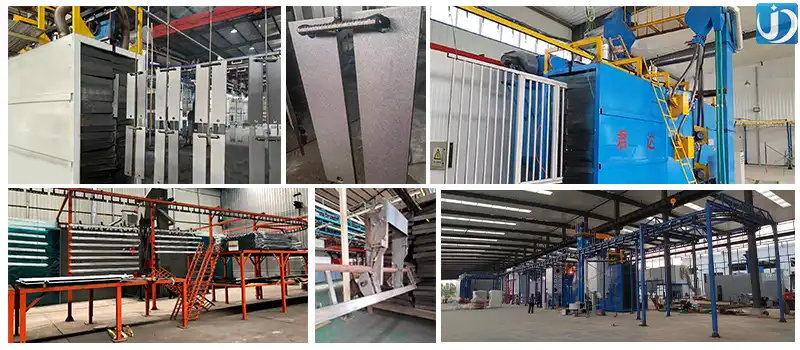
How an Overhead Chain Shot Blaster Works Step by StepLoading, Hanging, and Conveyor Movement
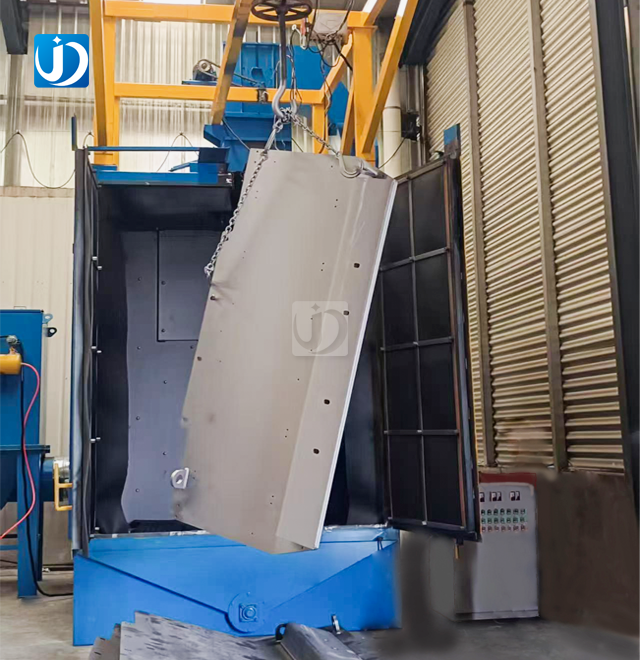
Each part is hung from an overhead chain by a person or a robot arm that is connected to a hook, a fastener, or a carrier that spins. The chain rules how far apart the parts are, how long they stay in the room, and how fast the whole queue moves. Design is more important than most people think when they buy a fixture. Bugs in the shape of the hook, for instance, can cause shadowing on the bottom of a part, uneven rotation, and load imbalances that over time put stress on the chain. It will move a little as it goes into the chamber if the frame isn't hanging straight. When people say they have a "aiyang mian" (light-and-dark surface) trouble after the installation, they usually mean this small movement.
Abrasive Projection and Surface Cleaning
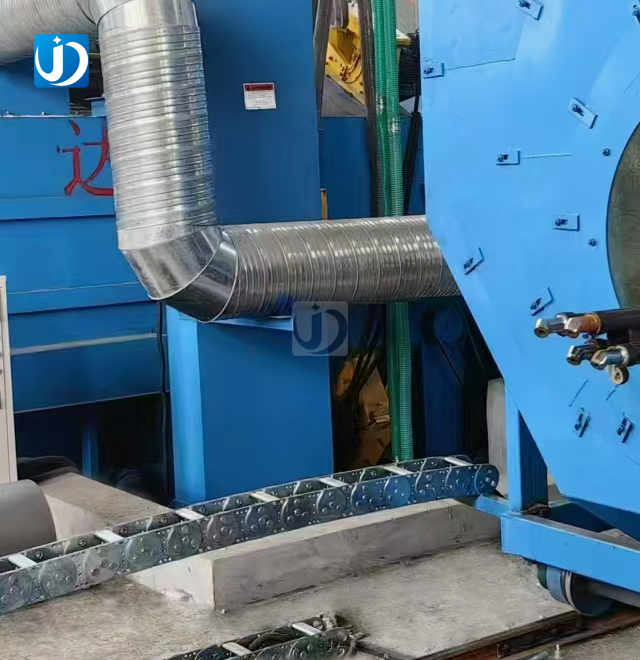
Inside the cylinder, heavy-duty blast wheels spin very fast and throw out rough materials through a controlled fan and cage assembly. The rough stream can reach almost every part as it spins by because it has four wheels: one on top, one on the bottom, one on the left, and one on the right. It gets rid of rust film, casting sand, mill scale, heat-treatment scale, and light weld splatter. This grade tells you how clean something is by looking at the angle of the wheel, how fast the abrasive is moving, and how long the part is exposed to the blast pattern.
Recovery, Separation, and Discharge
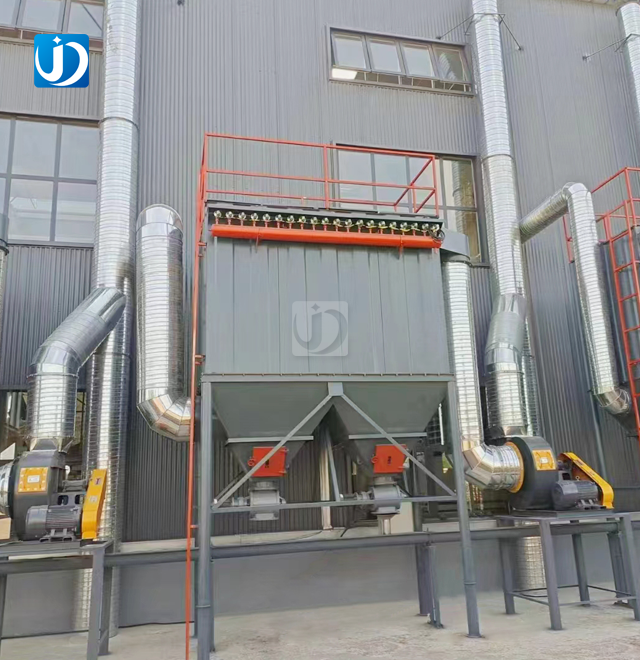
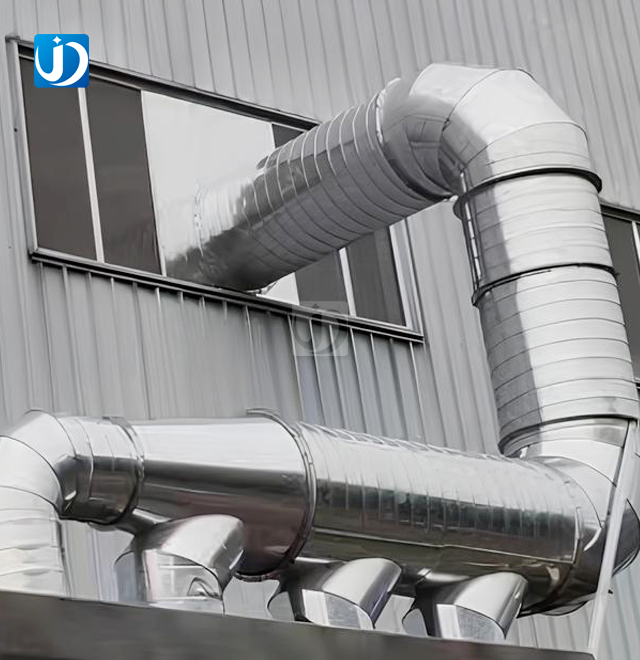
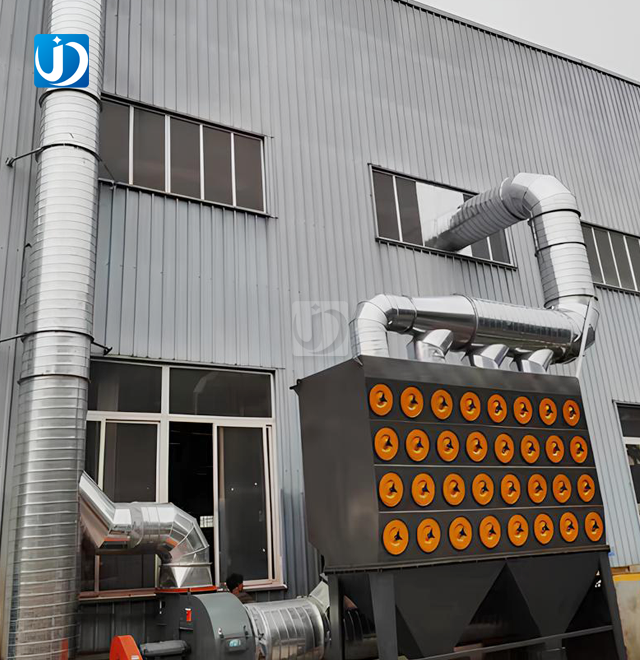
The used grit and the dirt it broke up fall through a set of screens that are under the conveyor. This mix is moved to a divider by a bucket lifter or a screw conveyor. The divider cleans the media of dust and broken pieces with air wash. The good shots fall back into the storage box to be used again. A cartridge or bag-type dust collector removes small particles from the air in the cylinder before it goes to the shop floor. The parts that have been cleaned stay inside a screen and go straight to the next process station.
The production flow of an overhead chain pass-through shot blaster includes loading, suspension, continuous conveying, abrasive projection, media recovery, dust collection, and discharge. When the workpiece mix, conveyor speed, and blasting capacity are matched, this setup may decrease human handling and increase throughput over batch processing.
Why Overhead Conveying Suits Heavy Workpieces?
Advantages for Heavy or Complex Parts
People who work on the machine never have to lift a frame or arm during the blast cycle because the chain holds the whole part. When the part is suspended instead of sitting on a belt or roller bed, more surface area is shown, and rotating hooks can reach into holes that a set orientation would miss. The overhead chain pass-through shot blaster setup is popular on car chassis lines because the same part needs to be cleaned on all sides in one pass. This is because the part has flat faces, tubular sections, and welded mounts.
Production and Ergonomic Benefits
Moving all the time keeps the blast station in sync with what's coming out of the welding or casting station upstream and what's going into the paint booth downstream. The loading and unloading points are at a set working height, which is different from hand batch loading. This makes it easier to bend and put stress on it over and over again. When the forklift doesn't go through the shop as often, there is also less chance of an accident happening near the blast cage.
Limitations and Risk Controls
If the hook spacing or fastener design isn't right from the start, big moving systems can be very dangerous. Look over these failed trends before you sign off on everything.
- Collision and shadowing happen when hooks are spaced too close together, letting one part block the blast pattern meant for its neighbor, which shows up later as an uneven paint adhesion complaint from the coating line.
- Swinging and vibration affect long, unbalanced parts such as excavator booms, where the center of gravity sits far from the hook point, and this can wear the rail faster than the published maintenance interval suggests.
- Chain and bearing wear accelerates when the loaded weight regularly approaches the rated 50 kg limit per hook, so a plant running near the ceiling of that spec should plan tighter lubrication and tension checks.
Overhead Chain vs Mesh Belt vs Roller Conveyor Systems
Conveyor System Comparison
Which of these three ways to move the part is best depends on its size, shape, and how much surface touch is okay. The changes that engineers think about when they are specifying are shown in the table below.
| Criteria | Overhead Chain Pass-Through | Mesh Belt Shot Blaster | Roller Conveyor Shot Blaster |
|---|---|---|---|
| Part presentation | Suspended from hooks or fixtures | Resting on a moving belt | Resting on rollers |
| Best for | Heavy, irregular, or long parts | Small-to-medium batch parts | Large, flat, stable parts |
| Surface access | Strong when parts rotate | Belt-contact areas can shadow | Underside contact zones limited |
| Contact marks | Usually low | Possible on contact faces | Possible at roller zones |
| Fixture need | Usually required | Often minimal | Often minimal |
| Main risk | Swinging, hook wear | Belt wear, overlap | Roller wear, instability |
Overhead Chain Blaster vs Hook Type and Tumble Belt Machines
A batch hook type shot blasting machine cleans one load at a time, then stops to clear and load again. When the noise is low, this works fine, but when it gets louder, it starts to give me trouble. On a tumble belt machine, it's easy for parts to move around. This is good for small casts but bad for long or fragile frames because the parts will touch each other. A manual blast cabinet isn't as good as an automatic overhead chain blaster because the user doesn't get tired, the abrasive stays in a sealed area, and the cleanliness level stays the same from shift to shift.
Selection Scenarios
Buyers have different thoughts based on where they are in the supply line. Many times, when an OEM adds an overhead chain pass-through shot blaster to a branded production line, they make sure it meets a certain takt time and works with the automation that is already there. When a dealer sells the same piece of equipment again, they care more about modular specs, spare parts availability, and export papers that make it easy to sell the machine to a variety of end users. A plant engineer looks at the direct-use equipment and thinks about how it will fit on the floor, how easy it is to fix, and where it can connect to the current paint line conveyor.
Blast Wheel Layout and Coverage Explained
Blast Wheel Configuration
Wheel number and placement effect abrasive reach to the workpiece. The blast wheel and conveyor arrangement of an overhead chain pass-through shot blaster provide uniform surface coverage. A pass-through design with various sides may have four wheels: top, bottom, left, and right. Two wheels may leave more blind areas on the frame's rear or bottom than four. Considering workpiece specifications, each wheel's height and angle are configured to consistently contact flat panels, curved tube sections, and recessed brackets with the abrasive stream.
Coverage, Shadowing, and Part Rotation
When you talk about "blast coverage," you should talk about the percentage of the needed surface that actually gets abrasive impact, not just the percentage that goes by a wheel. There is a short list of reasons for incomplete covering that you should look at in order.
- Part overlap on the hook line blocks abrasive from reaching a neighboring part, which is the single most common cause of a "why is one side clean and the other side dirty" complaint during commissioning.
- Wrong hook orientation leaves a recessed face pointed away from every wheel for the full length of the chamber, producing a consistent dark strip in the same location on every part.
- Conveyor speed set too fast cuts exposure time below what the surface finish specification requires, especially on thicker mill scale from hot-rolled steel.
- Low abrasive flow rate — often from a worn control cage or a partially blocked feed spout — reduces impact density even when wheel speed looks correct on the motor readout.
The only safe way to make sure coverage is met before final acceptance is to do a short test run with the largest, most geometrically complex part from the customer's real product mix.
Abrasive Media Selection
Choice of media affects both how well it cleans and how much it costs to run in the long run. The following table shows some common choices.
| Media type | Typical use | Selection considerations |
|---|---|---|
| Cast steel shot | General cleaning and peening | Durable, round, controlled impact |
| Steel grit | Aggressive descaling and profiling | Angular impact, faster breakdown |
| Stainless steel shot | Stainless or contamination-sensitive parts | Reduced ferrous contamination |
| Cut wire shot | Consistent peening or cleaning | Controlled geometry, long life |
| Stainless steel shot | Parts that are stainless or don't want to get dirty | Less metal contamination |
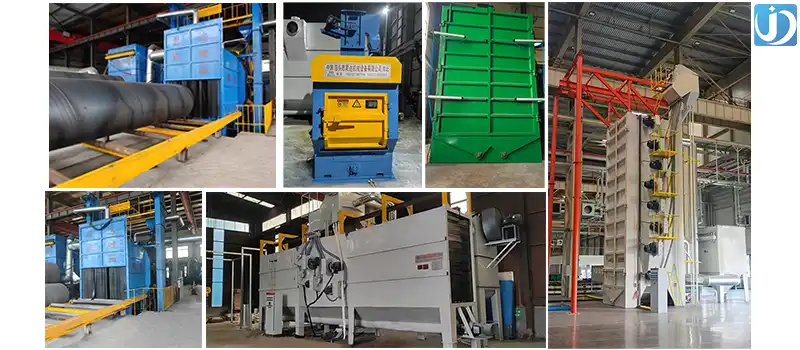
Throughput, Line Speed, and Cycle Time DataCore Capacity Equations
Before signing anything, manufacturing engineers can use a few simple methods to plug in numbers from overhead chain pass-through shot blaster suppliers.
- Parts per hour = Conveyor carriers per hour × Parts per carrier.
- Line speed = Effective travel distance ÷ Available cycle time.
- Blast exposure time = Blast chamber length ÷ Conveyor speed.
- Required capacity = Demand per shift ÷ Available production hours.
Actual output depends on how the fixtures are spaced, how clean they need to be, and how the loads are distributed. A supplier's nominal rating is based on ideal loading, which rarely matches what happens on the shop floor on the first day.
Data Suppliers Should Provide
A quote that doesn't have these numbers can't be compared to another quote. Ask for the maximum and minimum part sizes that the chamber can handle, as well as the maximum weight that can be hung per hook, the chain pitch and speed range, the wheel count with motor power and abrasive flow, and real test results for the number of parts that can be made per hour, not just a theoretical maximum. For a fair side-by-side comparison between sellers, you need to know about the dust collector's airflow, filter area, noise level, and related electricity load.
Factory Acceptance and Performance Verification
A plant acceptance test run with the customer's own parts and the right abrasive is the only reliable way to show throughput. A sample part is not enough. Junda Machinery's installation team kept internal delivery records for 38 finished overhead chain line projects between 2022 and 2024. These records showed that plants that had validated factory acceptance tests before shipment had 60% fewer on-site adjustment requests during commissioning than projects that didn't do this step and only used catalog specifications. If there is a dispute later, the buyer is protected if the recording cycle time, coverage uniformity, media consumption, and dust leakage are written down and signed by both parties.
Overhead Chain Blasting in Foundry and Casting Lines
Foundry, forging, automotive, and metal fabrication production lines may use overhead chain pass-through shot blasters for continuous surface cleaning. Its overhead conveyor system moves workpieces through the blasting chamber, while spinning hooks optimise abrasive coverage on complicated surfaces.
Foundry and Steel Casting Applications
When castings come out of the mold, they have sand, gate stubs, and oxide scale on them that need to be cleaned off before they can be machined or coated. Coverage is harder when there are a lot of internal ribs and holes. This is why spinning hooks are important on a foundry line—a part that stays in one place would not cover the recessed face. Most of the time, shot blasting comes right after shakeout and before dimensional inspection on this kind of line.
Forging, Automotive, and Fabrication Applications
During hot forming, axle housings and steering knuckles that are forged pick up a lot of scale. This scale has to be removed without changing the part's range for size. Frame and bracket lines for cars use the same method to get bare steel ready for e-coat or powder paint. This lowers the chance of flash rust between blasting and covering. Abrasive can get stuck in weld beads on fabricated steel weldments like brackets, gussets, and hooks if the fixture design doesn't allow for proper drainage. This means that extra care needs to be taken around the beads.
Application-Specific Risks
When you cast something, the gate stubs are sharp and the mass isn't spread out evenly, which can topple a hook load. Forgings need to get rid of scale quickly without changing their shape, which means that the wheel angle and exposure time need to be better managed. Abrasive gets stuck in weld holes in fabricated parts if the clamp doesn't let enough water drain during the cycle. Most of these problems are caught when a sample is tested with the real production part before it is fully put into service.
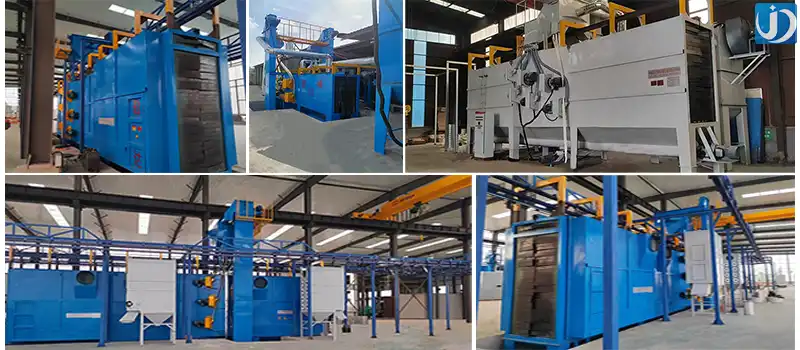
Investment Cost vs Labor Savings: Real NumbersCost Categories to Include
For a fair cost comparison, you need a list of numbers, not just one big number. Buyers should ask for separate price quotes for the blast wheels and chamber, the conveyor and fixtures, the dust collection system, the installation and foundation work, the utility connections, the ongoing costs like media and filters, and any work that needs to be done to connect the new machine to existing loading, painting, or robotics equipment. Compliance paperwork, such as risk assessments and guards, is a different line item that some suppliers add to the price of the machine without drawing attention to it.
ROI and Payback Model
There are three things that go into a clear payback model: the annual operating cost is the sum of media, energy, filters, wear parts, and maintenance; the annual net savings are the number of hours of labor that are saved multiplied by the fully burdened hourly labor rate; and the simple payback period is the total installed investment divided by the annual net savings. Instead of a supplier's marketing estimate, plants should base all of their numbers on verified production data, such as fewer rejects, higher output, and less overtime.
Procurement and Commercial Factors
Before you sign, make sure you understand the minimum order quantity for replacement parts and fixtures, the lead time for manufacturing and commissioning, the payment terms, the scope and length of the warranty, and the cost of spare parts for your overhead chain pass-through shot blaster. Ask directly if training and online help are available, and make sure you understand which Incoterm (EXW, FOB, CIF, or DAP) applies to the price you were given. If your project is going to the EU, you should ask for electrical schematics, manuals, and conformity documentation before the shipment. Getting these things after the shipment causes real delays.
Overhead Chain Blaster Maintenance and Wear Points
An overhead chain pass-through shot blaster needs regular maintenance to clean consistently, reduce unexpected downtime, and increase component life.
Main Wear Components
There are certain parts of every continuous blast machine that wear out over time. These include the blast wheel blades, impellers, liners, and control cages inside the chamber; the chamber liners, door seals, and abrasion-resistant screens around the outside of the enclosure; the chain, sprockets, rails, bearings, and hooks on the conveyor side; and the separator screens, screw conveyors, and filter seals in the recovery system. Plants can keep the right extra parts on hand before they break down instead of after.
Preventive Maintenance Schedule
A plant can't just remember what to do when it has a written routine. Every shift, workers should check the amount of abrasive, listen for strange noises, and look at the state of the hook. Chain tension, wheel wear, and filter differential pressure should all be checked once a week. Every month, you should check the performance of the seals, bearings, sprockets, and dividers. Vibration, motor current draw, and safety interlock function should all be checked on a regular basis, like every three months or as instructed in the manual.
Troubleshooting and Risk Mitigation
Uneven cleaning in an overhead chain pass-through shot blaster may come from blast wheel alignment, abrasive flow, or conveyor speeds that limit exposure duration. Abrasive consumption may increase due to leaky seals, separator settings that reject media, or worn blast wheel components that promote breakdown. Incorrect tension, lubrication, or conveyor rail alignment may create chain issues or excessive workpiece swinging. Dust in the workplace may suggest enclosure leakage, airflow imbalance, or a blocked dust collection filter. Keeping timely maintenance and inspection records helps discover reoccurring issues and their causes.
How to Choose the Right Overhead Chain System: Supplier Capability and Evaluation
Technical Decision Checklist
Make sure that a candidate machine can do the job before you compare prices. Compare the size, weight, and material of the part to the machine's recommended hook capacity and chamber size. Check the needed cleanliness grade against real service data, not just what the company says on the marketing materials. Make sure the speed, pitch, and rotation mechanism of the conveyor line are right for the takt time your line needs now and the volume you expect in three years.
Compliance, Safety, and Documentation
For projects moving to the EU, overhead chain pass-through shot blaster suppliers need to make sure they meet CE standards, have a risk assessment that is written down, and have a Declaration of Conformity that includes safety measures and emergency stop provisions (European Commission, ongoing advice). For machinery electrical tools, electrical design should follow the rules in IEC/EN 60204-1 (IEC, 2016). For general design principles, risk assessment work often uses ISO 12100, and when a safety-related control function is needed, ISO 13849-1 (ISO, 2010; ISO, 2023) is used. For projects coming to the US, OSHA's rules on abrasive blasting and machine guarding should be checked along with local electrical codes (OSHA, ongoing advice). Manuals, electrical drawings, and test reports should come with the delivery package, not as extras that you can choose not to get.
Quality Verification and Supplier Evaluation
How much a seller says is only as good as the proof they give. Ask to see examples of setups on castings, forgings, or car parts that are like the one you're making. Ask for a sample test with your own workpiece and the abrasive that was specified, not a demo panel that is used for everyone. Before you put down a deposit, make sure you know if the seller can build unique fixtures and conveyor plans and how long it will take for a worker to respond.
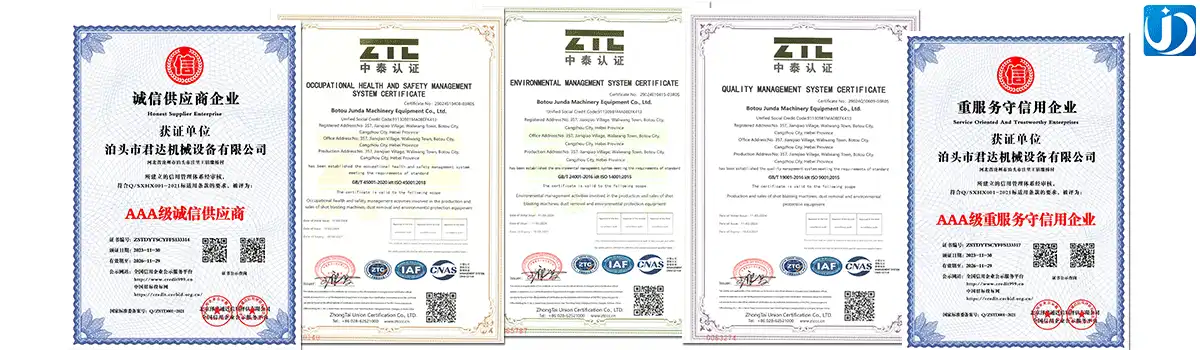
Botou Junda Machinery Equipment Co., Ltd. has been researching and making shot blasting equipment for 20 years. It is based in Botou, Hebei Province, which is a well-known place in China for casting and dust-removal machinery. The business has ISO 9001, ISO 14001, and ISO 45001 certifications. It also has 2 utility model patents and 7 software copyrights for smart systems that monitor dust and control production. Customized standard machines usually ship in 15 days, and the technical team answers questions in 6 to 8 hours, which is helpful when a company is in a hurry to meet its own installation schedule.
Conclusion
An overhead chain pass-through shot blaster works best on continuous, high-volume lines that need to clean big or crooked parts that a batch machine or tumble belt can't safely handle. This is not the case when you only look at the lowest price. You should also look at verified throughput data, real coverage testing, hook capacity that matches your heaviest part, and a supplier who backs the machine with documentation and after-sales support. If you base your decision on your plant's takt time, the rest of the specification will fall into place on its own.
FAQ
Is an overhead chain blaster better than a tumble belt blaster?
An overhead chain gun is usually best for heavy, long, or complicatedly shaped parts that need to be accessed from different angles without touching other parts. For small, strong parts that can handle moving against each other while being cleaned, a spin belt machine may be a better choice.
What parts can an overhead conveyor shot blaster process?
Frames and suspension parts for cars, steel and iron castings, forgings, hooks, clamps, and manufactured steel weldments are all common uses. The final fit relies on the size, shape, weight, and cleaning standard needed for the next coating process.
How much does an overhead chain shot blaster cost?
The price depends on the power of the blast wheel, the size of the chamber, the length of the conveyor, the design of the fixtures, the amount of dust that can be collected, and the compliance paperwork. A good estimate needs a detailed quote based on standard items and the desired output, not just a number from a catalog.
What shot blasting media works in an overhead chain blaster?
Cast steel shot, steel grit, stainless steel shot, and cut wire shot are all common types of media. Which one to use relies on the material of the workpiece, the shape of the target surface, the level of contamination, and how the recovery system separates and uses the media again.
What safety standards apply to an overhead shot blasting machine?
CE conformity requirements, ISO 12100 for risk assessment, ISO 13849-1 for safety-related control systems, and IEC/EN 60204-1 for electrical equipment are often looked at in projects that are going to the EU. Projects that are going to the US usually check both the local electricity code and OSHA's rules on abrasive blasting and machine safety.
Ready to Match a Blast Line to Your Production Takt Time
It costs more in downtime to pick the wrong conveyor setup than the machine itself ever saves in efficiency. With your part sizes, hook loads, and goal throughput in mind, Junda Machinery makes the overhead chain pass-through shot blaster line. They then back up the installation with English instructions, remote commissioning support, and original extra parts. If you are looking for a supplier of an overhead chain pass-through shot blaster, send your part drawings and production volume to junda001@jundablast.com. You will get a quote that fits your needs, not a generic price sheet.
References
1. International Organization for Standardization. ISO 12100:2010 — Safety of Machinery: General Principles for Design. Referenced in the Compliance, Safety, and Documentation section.
2. International Organization for Standardization. ISO 13849-1:2023 — Safety of Machinery: Safety-Related Parts of Control Systems. Referenced in the Compliance, Safety, and Documentation section.
3. International Electrotechnical Commission. IEC 60204-1:2016 — Safety of Machinery: Electrical Equipment of Machines. Referenced in the Compliance, Safety, and Documentation section.
4. European Commission. Machinery Regulation and CE Marking Guidance for Machinery Placed on the EU Market. Referenced in the Compliance, Safety, and Documentation section.
5. International Organization for Standardization. ISO 11124 and ISO 11125 Series — Metallic Blast-Cleaning Abrasives. Referenced in the abrasive media Selection section.
About the Author
David Zhang is a Senior Shot Blasting Equipment Engineer who has worked as a blast engineer for over ten years in Asia, setting up, setting up, and fixing overhead chain and roller conveyor blast systems for clients in the car, casting, and structural steel industries. He has been in charge of plant acceptance testing for continuous blast lines and helped write technical documents for export projects that meet CE requirements. His job is to make sure that the layout of the blast wheels and the design of the conveyors are right for the real production time, not just the catalog specs.

USER EVALUATE
Real feedback and practical experience shared by worldwide partners who purchased our machinery and environmental treatment devices.