
Types of Shot Cleaning Machines and Their Applications
The main types of shot cleaning machines are hanger (rotating-hook), roller-conveyor, monorail pass-through, drum, rotary table, and air-blast models. Each type holds metal parts differently, so each suits different workpiece sizes and production rates. A shot cleaning machine throws steel shot or grit at plates, castings, pipes, and structural parts to remove mill scale, rust, welding slag, and foundry sand. Hook and pass-through designs fit large, heavy parts, while drums fit small, durable parts in bulk. In this guide, I explain how these machines work, where they apply, and how to choose one.
How a Shot Cleaning Machine WorksCore Operating Principle and Components
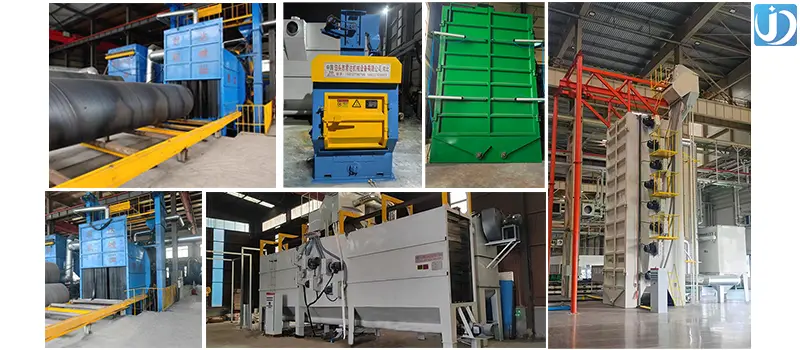
An enclosed system is what a shot cleaning machine is. Parts are moved into a sealed chamber by a conveyor belt, hook, table, or drum. The steel is then thrown at up to 60–90 m/s by centrifugal blast wheels. Even on complicated shapes, the impact removes welding slag, corrosion, and mill scale. The walls of the room are protected from repeated abrasive hits by frames made of high-manganese steel that is 60+ HRC hard. The media stays inside thanks to stronger seals at the entrance and exit. Our hook-type systems spin at 2–4 r/min, which means that the blast stream hits every side of the part. During the whole cycle, operators stay out of the blast zone.
Abrasive Recycling and Dust Control
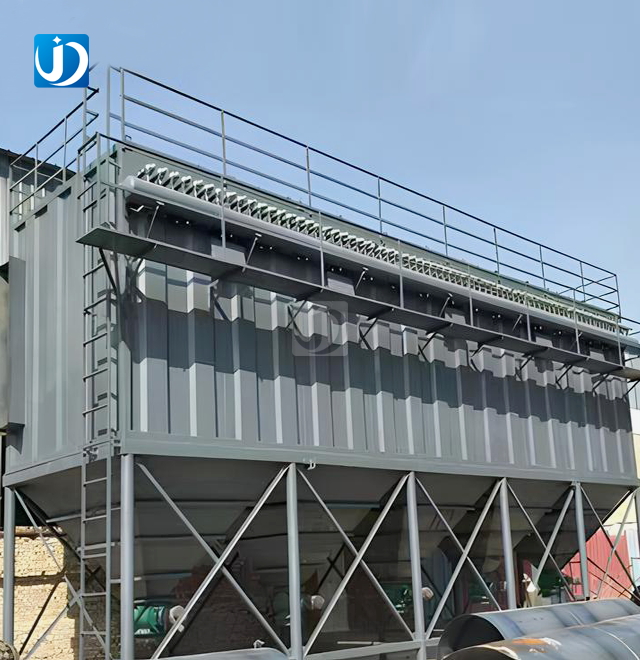
When it hits something, the abrasive falls to the floor of the chamber. You can get it to an air-wash separator with a screw conveyor and a bucket elevator. This separator, which works 99.5% of the time, takes dust and broken media away from intact shot and sends the intact shot back to the blast wheels. Compared with open-loop systems, this closed loop can save up to 40% of the abrasive that would have been used. The room is kept under negative pressure by a pulse-jet cartridge dust collector, and emissions from the workplace are kept below 50 mg/m³. This answers two common complaints from foundry managers: the high cost of media and the heavy dust on the floor.
Shot Cleaning vs. Shot Blasting vs. Sandblasting
People who are buying things often mix these terms up. A clean metal surface is what shot cleaning is all about. Abrasive impact is what shot blasting is all about. Sandblasting usually refers to mineral media that is used only once and is pushed by compressed air. Steel shot, on the other hand, can be used over and over again. Centrifugal wheels have a bigger impact and can move more material than air blasting, and they use less media. The standard for respirable crystalline silica set by OSHA (29 CFR 1910.1053) says that people can be exposed to no more than 50 micrograms per cubic meter for eight hours. Because of this limit, U.S. companies should pay close attention to silica-free metallic media.
Main Types of Shot Cleaning Machines
Hanger and Rotating-Hook Machines
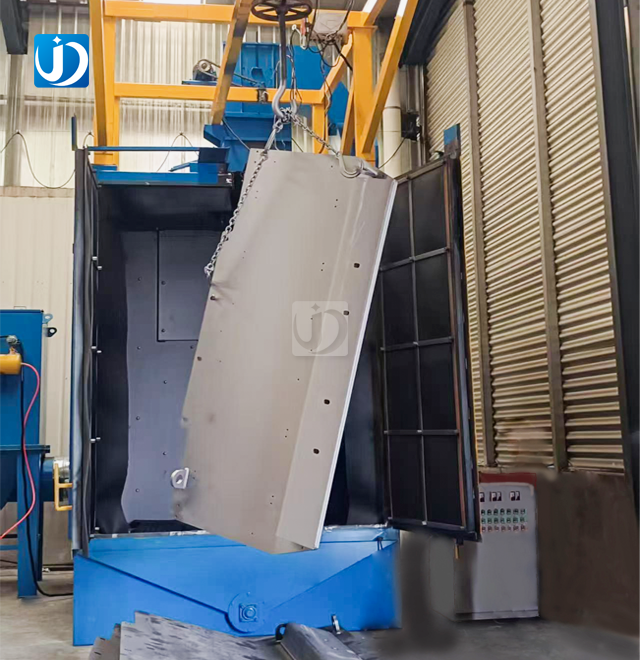
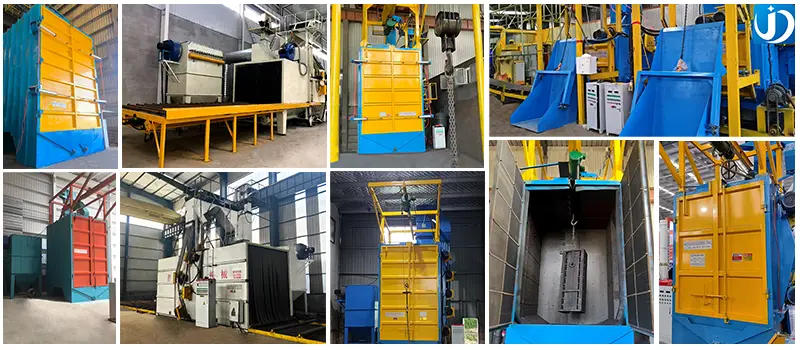
Hanger machines hang parts inside the room from hooks. They work well with big or odd-shaped parts, like engine blocks, car frames, and big castings. With our rotating-hook models, you can lift up to 10,000 kg with a single hook. The hook turns at 2–4 r/min to reach every surface. Because the parts don't bump into each other, this motion has no dead zones and protects accurate features. It takes longer for hanger machines to load than for continuous lines. They work better for mixed-part production than high-volume work on a single product. This type gives you the most freedom when your part sizes change from week to week.
Roller-Conveyor and Monorail Pass-Through Machines
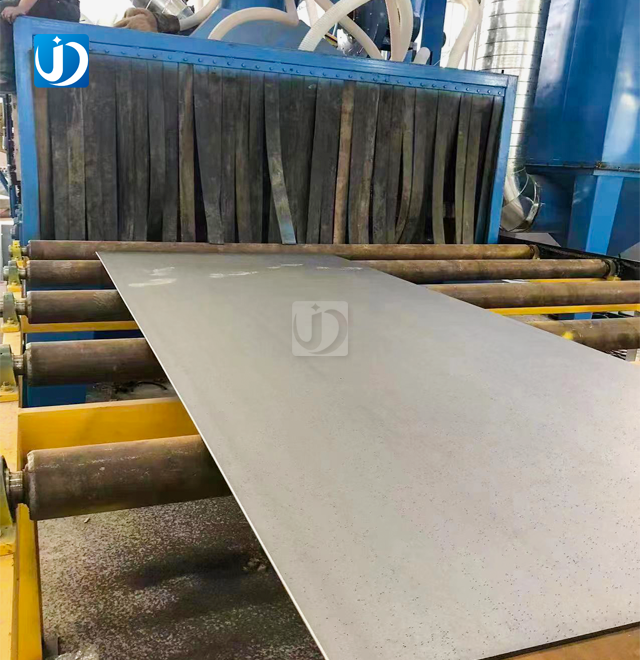
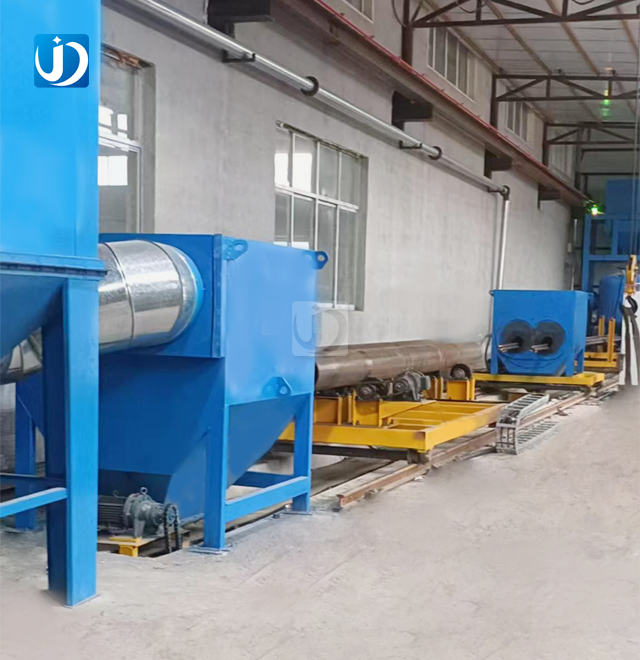
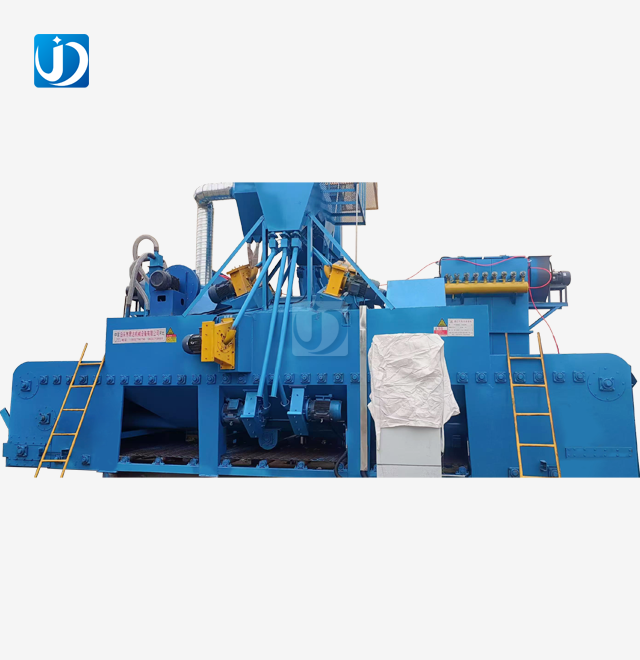
Machines that move work through the blast zone without stopping do not stop. Roller-conveyor types clean steel plates, profiles, and pipes in a steady stream. Monorail pass-through systems use an overhead rail to move large structures through the chamber, like parts of construction machinery that have been built. With anywhere from 4 to 12 blast wheels, a multi-wheel layout can cover all faces in one pass. With power ranges from 37 kW to 160 kW, our units can handle 1 to 15 tons per hour. This layout cuts down on manual work and can connect to downstream coating lines.
Drum, Table, and Air-Blast Machines
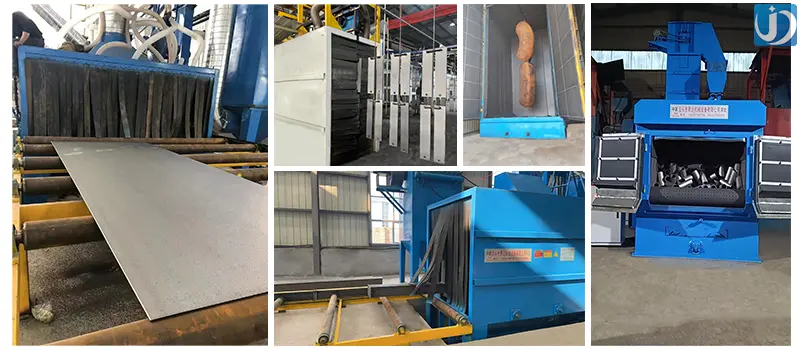
Different styles fill certain needs. Small forgings and other durable bulk parts are turned by drum machines so that shot gets to every piece. Fragile parts or flat parts that fit together well don't work with them. Rotary table machines can hold groups of parts and expose medium-sized parts in a controlled way. A compressed-air nozzle lets the operator focus on a single weld or corner on an air-blast machine. In terms of how much they move, they are not as rough as wheel systems. Centrifugal hook, roller-conveyor, and monorail systems make up most of our products. Our ODM/OEM service can make equipment fit the layout of your facility.
Shot Cleaning Machine Applications by IndustryShipbuilding and Heavy-Duty Manufacturing
Heavy plates and H-beams come with mill scale that makes it hard for paint to stick. Before welding or painting, that scale is taken off by a pass-through shot cleaning machine. The ISO 8501-1 Sa 2.5 level of surface treatment is what our equipment does. The standard says that this grade is a very thorough blast cleaning: there is no oil, grease, dirt, mill scale, rust, paint, or even a little staining that can be seen. In the U.S., SSPC-SP 10/NACE No. 2, which is near-white metal blast cleaning, is the most exact match. Marine coatings need a clean base, so marine projects often ask for it to be long-lastingly resistant to corrosion.
Foundries and Casting Operations
When the castings come out of the mold, they have burnt-on sand, flash, and in the case of investment casting, ceramic shell leftovers. Cleaning by hand takes a long time and is hard on the people who do it. Ceramic shell residue and burned-on molding sand are taken off of engine blocks, pump housings, and valve bodies by a hook-type machine. Before cutting or assembly, high-intensity cleaning keeps the dimensions within acceptable ranges. Usually, three things that foundry managers look at are steady Sa 2.5 results, the life of the blast wheel, and how quickly worn parts can be delivered. Our high-chromium alloy blast wheels make even blast patterns and don't need to be serviced for more than 800 hours of normal use.
Automotive and Construction Machinery Components
Before coating, vehicle frames, construction-machinery parts, and structural parts need a clean, evenly rough surface. Paint can stick to an anchor profile that can be changed. They change the wheel speed, exposure time, and media size (S110 to S550 under SAE J444) and also switch between steel shot and steel grit. This gets grades of Sa 2.0 or Sa 2.5. Shot peening is also done to some automotive parts, like crankshafts, springs, and gears. When you peen something, you create a layer of compressive stress that resists fatigue, and Almen strip testing shows how strong it is. Talk to your engineer about the process goal before you choose equipment.
How to Choose the Right Shot Cleaning Machine?Start with Workpiece and Surface Standard
Start with your parts. Write down the size, weight, material, how hard or fragile it is, the state of the surface, the batch size, and the daily amount. Then write down the finish you want, like Sa 2.0 or Sa 2.5 under ISO 8501-1, as well as the anchor profile your coating supplier needs. You can find out how to measure the profile of blast-cleaned steel in ASTM D4417. Heavy single parts point toward a hanger machine. Roller-conveyor types are suited for long plates and pipes. Small, tough parts in bulk point toward drums. Fragile aluminum castings need less impact energy and smaller media. If you match the part first, you won't have to buy a chamber size that you won't need.
Compare Throughput, Abrasive Use, and Operating Cost
The size of the chamber itself doesn't tell you how much it can hold. You can ask for tons per hour, cycle time, the number of blast wheels, and the abrasive flow rate. Our range is between 120 and 350 kg/min. Line speed should match the line that is casting or coating so that the cleaner doesn't slow things down. Keep track of how much abrasive is used in each batch. A separator that lets in too much air pulls good shot into the dust collector, which increases consumption. Don't put too much on the hooks, and check the media size mix often. Automatic systems cost more to set up at first than manual ones, but they save time and effort by not having to do the same things over and over. Compare not just the purchase price, but also the cost of owning the equipment over a number of years.
Check Dust Control, Safety, and Supplier Support
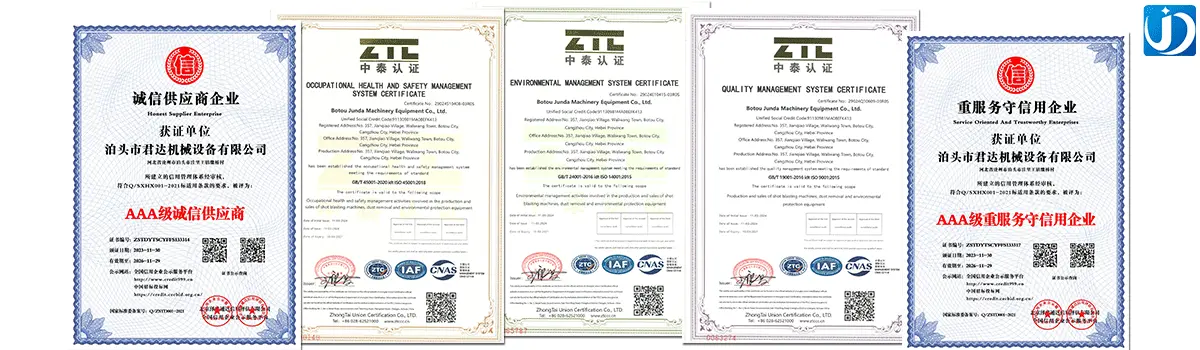
The amount of air going into the dust collector of a shot cleaning machine should be right for the chamber size and number of wheels. Our line goes from 3,000 to 15,000 m³/h. Find out what each supplier's emission goals are. We use pulse-jet cartridge collectors to keep ours below 50 mg/m³. Also, look at the safety stops and interlocks. Then look at the quality system of the provider. Our company is certified by ISO 9001, ISO 14001, and ISO 45001, and we can also help with CE certification, export documents, and test reports. We also offer English manuals, training for operators, and help with remote installation. Before you commit, ask any supplier to test samples of your parts.
Maintenance, spare parts, and BuyingRoutine Inspection Checklist
A short routine helps keep the cleaning up to par. Look at how worn out the blast wheel's blades and liners are. Blades that are worn out don't throw as much abrasive, which means they clean less well. Look for leaks in the seals, hear and feel the noise and heat from the bearings, and see how worn out the conveyors are. Check the filter cartridge's condition once a week and the pulse-jet pressure every day to keep the flow steady. It's important to check the emergency stops and safety interlocks every so often. The number of inspections that need to be done relies on the work being done, the type of abrasive being used, and the hours that the business is open. For more than 800 hours, our high-chromium blast wheels can work with normal loads before they need to be repaired. But your records will show you how long it really was between visits.
Troubleshooting Common Problems
Link each sign to the cause that seems most likely. Uneven cleaning is often caused by worn blades, an uneven mix of abrasives, or parts that are not in the right place. The separator has too much air in it because it is being used too rough. If you can see dust, it means that filters or seals are broken or worn out. Ask to have a balance test done on a blast wheel before you buy it. Vibrations can mean that it isn't balanced, which also hurts the bearings' life. Most of the time, a clogged hopper is caused by large pieces of debris or a dirty working mix. The mix stays clean because it is sieve-tested often. This is important because every hour that your casting lines are down costs you money in lost work. Make sure that these checks are part of your repair plan.
Spare Parts and Preparing Your Request for Quote
It is useful to have extra separater parts, seals, bearings, filters, sensors, and blast wheel blades on hand. We keep quick delivery channels open for real wear parts, and we answer technical questions within 6–8 hours. You should include drawings or photos, the size, weight, batch size, surface condition, cleaning standard, daily volume, factory layout, utilities, and the country where the goods will be sent when you ask for a quote. A clear price spells out the parts of the machine, the cycle time, the number of blast wheels, the dust collector, the spare parts, the installation, the warranty, and the delivery terms. Our basic models are always in stock, and it takes about 15 days to make a brand-new one.
Conclusion
There is a right shot cleaning machine for every job, every surface, and every speed of output. Hanger and rotating-hook machines are good for parts that are heavy or don't fit together right. Systems with rollers and monorails are good for working with plates, pipes, and structures all the time. You can get more done with drums, tables, and air-blast units. You can get reliable Sa 2.0 or Sa 2.5 results while using little media and releasing few emissions if you use centrifugal blast wheels, closed abrasive recycling, and pulse-jet dust collection. Every shift in the shipbuilding, casting, auto, and construction machinery industries makes the best choice. Buyers should examine more than just chamber size. They should also look at throughput, abrasive consumption, dust control, and the cost of ownership. Also, they do better if they plan ahead for repairs and spare parts.
FAQ
What is the difference between shot cleaning and shot blasting?
After a shot, the goal is a clean surface. The abrasive-impact process is known as shot blasting. A lot of plants call the same thing by both names.
Can I use steel grit instead of shot?
Yes, if the liners and blades are made to work with the rougher grit. If not, wear will happen faster.
How do I choose the correct shot size?
Smaller shot covers more ground and makes the finish smoother. A bigger shot gets rid of heavy scale. Look at the SAE J444 chart and the profile requirements set by your coating supplier.
How does the machine control dust?
The chamber is under negative pressure because of a pulse-jet cartridge dust collector. This keeps the dust inside the system.
Why is my cleaning efficiency dropping?
Sometimes it's because the blast wheel blades are worn out or the abrasive mix isn't balanced. Look at the blades and the options for the air-wash separator.
Request a Shot Cleaning Machine Quotation from Junda Machinery
Junda Machinery wants to see your drawings, photos, and Sa 2.5 requirements. As a shot cleaning machine manufacturer in Botou, Hebei, with 20 years of experience, we offer standard models in stock, custom builds in about 15 days, ODM/OEM options, and replies within 6–8 hours. Email junda001@jundablast.com or visit jundablast.com, and our engineers will recommend a configuration, capacity estimate, and spare-parts list for your line.
References
1. ISO 8501-1: Preparation of Steel Substrates Before Application of Paints and Related Products – Visual Assessment of Surface Cleanliness, International Organization for Standardization, 2007
2. ISO 8504-2: Preparation of Steel Substrates Before Application of Paints and Related Products – Surface Preparation Methods – Abrasive Blast-Cleaning, International Organization for Standardization, 2019
3. ISO 11124-1: Preparation of Steel Substrates Before Application of Paints and Related Products – Specifications for Metallic Blast-Cleaning Abrasives, International Organization for Standardization, 2018
4. SAE J444: Cast Shot and Grit Size Specifications for Peening and Cleaning, SAE International, 2005
5. ASTM D4417: Standard Test Methods for Field Measurement of Surface Profile of Blast Cleaned Steel, ASTM International, 2021
6. Respirable Crystalline Silica Standard, 29 CFR 1910.1053, Occupational Safety and Health Administration, 2016

USER EVALUATE
Real feedback and practical experience shared by worldwide partners who purchased our machinery and environmental treatment devices.